The Hostage Internet: How Private Equity Bought cPanel, Plesk & WHMCS to Build a $1B Hosting Monopoly
For more than two decades, the global web hosting industry operated on an unspoken, foundational covenant: hardware was commoditized, software was empowering, and infrastructure tools existed to unleash human entrepreneurial energy. A teenager in Warsaw, a freelance web agency in Austin, or an independent ISP provider in Dhaka could spin up a bare-metal server, install a control panel, configure a billing script, and launch a web hosting company with almost zero barrier to entry. The software license was a predictable, flat-rate operational expense—typically $15 to $35 per month for an entire physical machine capable of hosting hundreds or even thousands of independent websites.
Between 2017 and 2020, that sacred covenant was systematically assassinated.
In what financial historians and tech analysts now recognize as one of the most calculated, aggressive software rollups in the history of enterprise computing, a coalition of private equity mega-funds—spearheaded by Oakley Capital and later backed by CVC Capital Partners—embarked on a silent shopping spree. With surgical precision, they acquired the indispensable plumbing of the commercial internet: Plesk, cPanel, WHMCS, SolusVM, and Kayako. They consolidated these formerly competing, independent pillars into a single monolithic holding conglomerate: WebPros.
When the dust settled, a single corporate boardroom held the operational keys to more than 80% of the world's commercial web hosting infrastructure. What followed was not a renaissance of software innovation, technical modernization, or infrastructure stability. Instead, the global hosting industry was subjected to the classic private equity playbook: the sudden abolition of unlimited licensing, the imposition of compounding annual per-account "licensing taxes," artificial lock-in mechanics, and the deliberate economic extraction of billions of dollars from independent web hosts, agencies, and small businesses worldwide.
This is the untold investigative story of how the open web was financialized, how millions of webmasters became digital hostages, and how the modern developer counter-revolution is permanently breaking the monopoly.
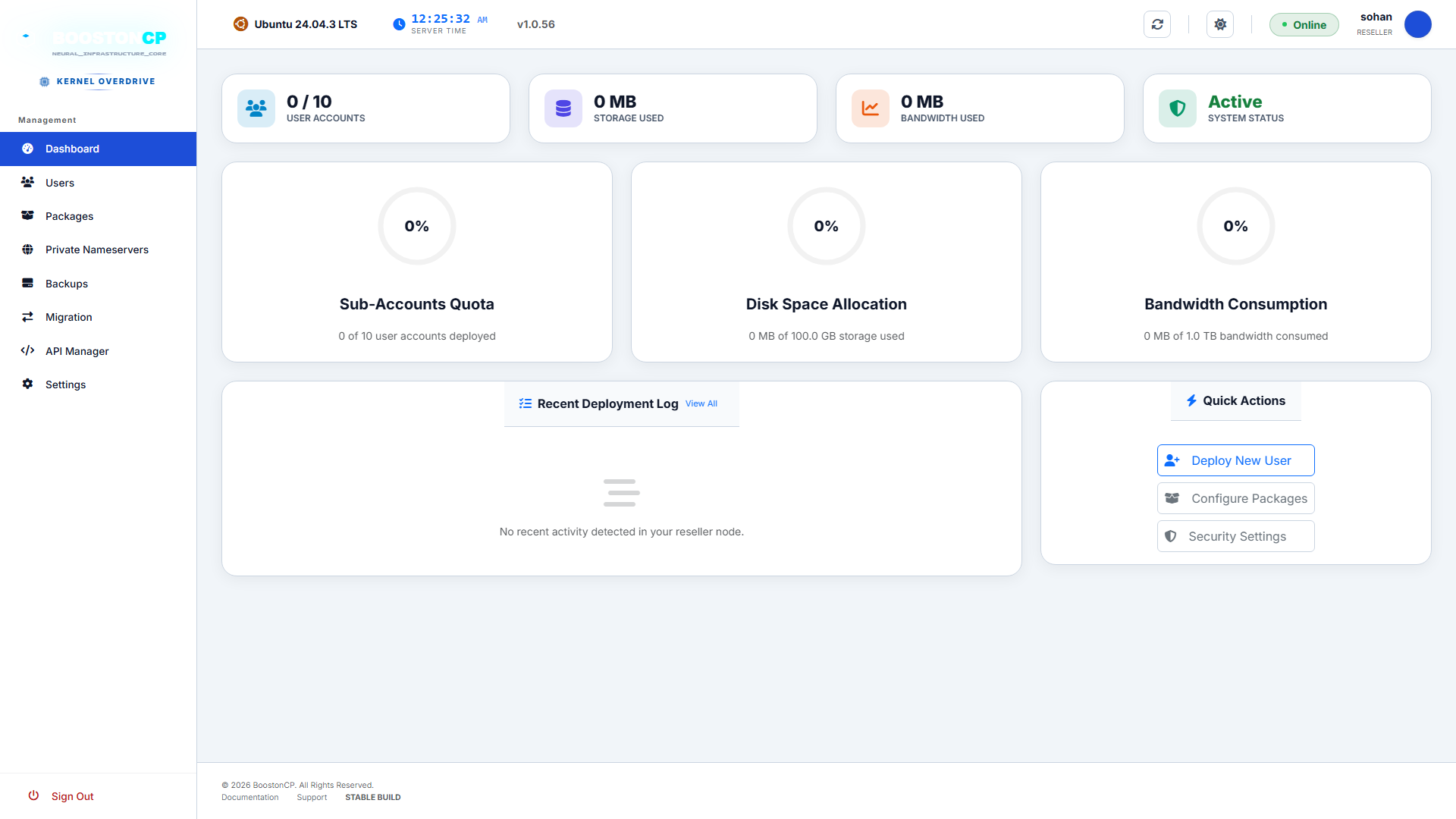
The Autonomous Multi-Tenant Infrastructure: Managing Reseller Fleets Without Corporate Hostage Taxes
Chapter 1: The Golden Age of Independent Hosting (1996–2016)
To understand the magnitude of the modern crisis, one must revisit the early architectural philosophies that built the commercial web. In 1996, when Nick Koston created cPanel in Houston, Texas, web hosting was chaotic, fragmented, and fundamentally manual. Setting up a virtual host required hand-editing Apache httpd.conf files, compiling Perl scripts from source, manually provisioning BIND zone files for DNS records, and writing custom shell scripts to monitor Sendmail queues.
cPanel turned this arcane, command-line sysadmin ritual into an accessible, graphical point-and-click interface. Anyone who could afford a leased server could suddenly become a hosting company.
Critically, the business model reflected the ethos of the early web. cPanel Inc. sold their software on an unlimited server license model. Whether a hosting entrepreneur hosted 5 websites or 2,500 websites on a dual-Xeon server, the software license remained a static, unvarying cost: roughly $15 to $20 per month for a Virtual Private Server (VPS), or $35 to $45 per month for a dedicated bare-metal machine.
This flat-rate pricing paradigm created a golden economic flywheel:
+-----------------------------------------------------------------+
|                     THE GOLDEN AGE FLYWHEEL                     |
|                                                                 |
|   Predictable Software Cost ($35/mo flat dedicated license)     |
|                              │                                  |
|                              ▼                                  |
|   Hardware Densification (Faster CPUs, NVMe SSDs, more RAM)     |
|                              │                                  |
|                              ▼                                  |
|   Lower Hosting Unit Economics ($1 - $3/mo shared hosting)      |
|                              │                                  |
|                              ▼                                  |
|   Explosive SMB Internet Onboarding (Millions of websites born) |
+-----------------------------------------------------------------+
Hosting companies were financially incentivized to optimize their infrastructure, install faster processors, configure caching engines, and pass the economic savings down to their clients. An agency could host 50 client websites on a single server, charge each client $20/month for maintenance, and pocket healthy, sustainable margins without worrying that their underlying software vendor would suddenly demand a cut of every single tenant.
Similarly, Matt Pugh's creation of WHMCS (Web Host Manager Complete Solution) in 2005 provided an automated billing, provisioning, and ticketing engine that seamlessly integrated with cPanel and Plesk. For a modest one-time perpetual purchase or a $15/month lease, an entrepreneur owned a complete, end-to-end, automated digital hosting conglomerate.
The industry flourished. Thousands of independent web hosting brands competed aggressively on customer service, hardware reliability, and technical innovation. The web was diverse, decentralized, and economically democratic.
Then, institutional private equity discovered the balance sheets.
Chapter 2: The Leveraged Buyout Rollup — The Genesis of WebPros
In the private equity ecosystem, software is revered above almost all other asset classes. But within software, one specific sub-category represents the holy grail of investor returns: sticky, mission-critical infrastructure software with prohibitive switching costs.
When an enterprise buys a social media marketing tool or an internal chat app, switching to a competitor is relatively painless. But when a web hosting company with 10,000 active client accounts runs on a specific control panel, changing that software is an operational nightmare of catastrophic proportions. It involves migrating terabytes of MySQL databases, moving hundreds of thousands of mailboxes with imap synchronizations, re-training entire technical support departments, and rewriting thousands of custom API integrations.
Private equity analysts realized that web hosts would endure almost any level of economic pain before risking a live, multi-server migration. The customers were trapped. All that was required was to consolidate the market to eliminate any viable commercial alternatives.
The Acquisition Timeline: Assembling the Trap
The systematic consolidation unfolded in rapid, deliberate phases between 2015 and 2019:
2015 ───► Oakley Capital acquires Plesk from Parallels (Cross-platform monopoly secured)
           │
2017 ───► cPanel & WHMCS deepen exclusive corporate ties; SolusVM acquired
           │
2018 ───► Oakley Capital officially acquires cPanel Inc. (The rivalries vanish)
           │
2019 ───► WebPros formed as holding group; CVC Capital buys majority stake at $1.5B+ valuation
           │
2019 ───► The "Black Tuesday" pricing shockwave hits the global hosting market-
The Neutralization of Plesk (2015–2017):
Plesk, originally developed by Parallels, was the only formidable global commercial competitor to cPanel, dominating the Windows hosting market and commanding a massive market share across Europe and Asia. When Oakley Capital carved Plesk out of Parallels, the European flank was captured. -
The Acquisition of cPanel (August 2018):
In August 2018, the bombshell announcement was released: cPanel Inc. was acquired by a consortium led by Oakley Capital. Overnight, the two legendary rivals that had kept each other honest for nearly two decades were owned by the exact same financial master. The illusion of a competitive market evaporated. -
Consolidating the Nervous System (WHMCS & SolusVM):
Simultaneously, WHMCS—which controlled 85%+ of automated hosting billing—and SolusVM—which controlled the virtualization layer for thousands of VPS providers—were folded into the fold. The corporate entity created to house this consolidated monopoly was christened WebPros. -
The Billion-Dollar CVC Mega-Deal (December 2019):
To cement the financialization, private equity titan CVC Capital Partners acquired a majority interest in WebPros in a secondary leveraged buyout valuing the entity at well over $1.5 Billion USD.
When a private equity consortium borrows hundreds of millions of dollars in debt (leverage) to acquire a software monopoly at a multi-billion-dollar valuation, they do not generate their mandated 25%+ Internal Rate of Return (IRR) by developing neat new features or politely asking for voluntary contributions.
They generate it through aggressive, monopolistic price extraction.
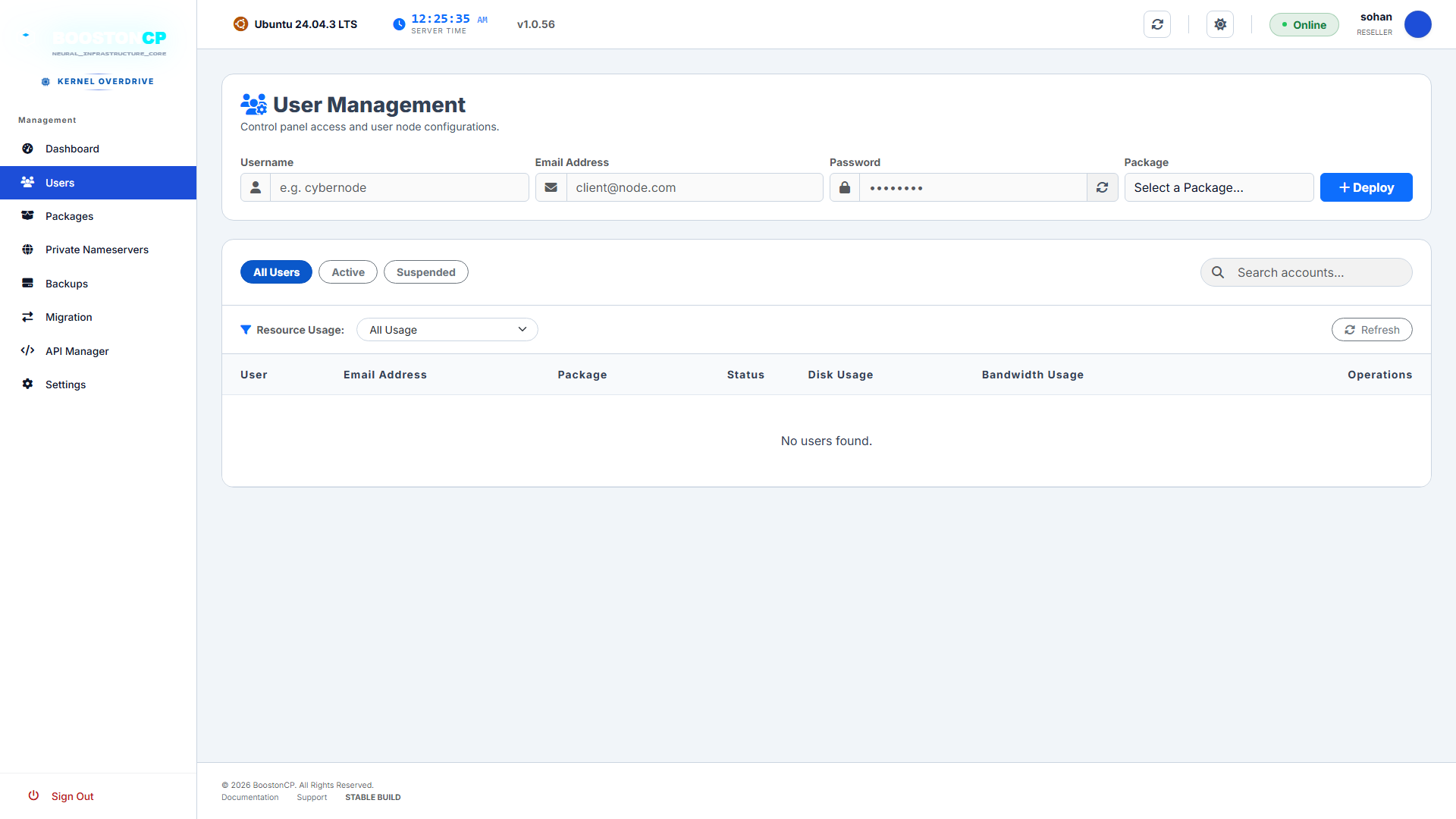
Multi-Account Isolation: Provisioning Hundreds of Client Workloads Without Incremental Per-User Surcharges
Chapter 3: 'Black Tuesday' — The Abolition of Unlimited Hosting
On the morning of June 27, 2019, an email landed in the inboxes of tens of thousands of web hosting executives, agency owners, and independent system administrators worldwide. In the annals of hosting history, this day is universally referred to as "Black Tuesday."
With zero prior industry consultation and giving companies barely 60 days to adjust their annual budgets, cPanel unilaterally announced the immediate termination of the unlimited server license.
Effective September 1, 2019, licenses would no longer be sold per machine. Instead, cPanel introduced a tiered, per-account licensing structure:
- cPanel Admin: Up to 5 accounts — \$20/month
- cPanel Pro: Up to 30 accounts — \$30/month
- cPanel Premier: Up to 100 accounts — \$45/month
- Each Additional Account Above 100: \$0.20 per account per month (later hiked repeatedly to \$0.30, \$0.39, and higher).
The Mathematical Carnage
To understand the absolute shockwave this caused, examine the real-world operational economics of a mid-sized independent hosting company running modest, density-optimized hardware:
Consider a hosting company operating 10 dedicated bare-metal servers, each hosting 1,000 small business websites:
| Parameter | Under the Traditional Unlimited Model | Under the WebPros Per-Account Model (2019) | Under Current Compounding Pricing (2026) |
|---|---|---|---|
| Total Physical Servers | 10 Bare-Metal Dedicated Servers | 10 Bare-Metal Dedicated Servers | 10 Bare-Metal Dedicated Servers |
| Total Hosted Client Accounts | 10,000 Accounts | 10,000 Accounts | 10,000 Accounts |
| Monthly Software License Cost | \$450.00 / month (\$45/server) | \$2,250.00 / month (\$45 + 900 × \$0.20 per server) | \$4,050.00+ / month (\$60 + 900 × \$0.39 per server) |
| Annual Software License Tax | \$5,400.00 / year | \$27,000.00 / year | \$48,600.00+ / year |
| Percentage Increase | Baseline | +400% Instant Hike | +800% to +1,000% Extortion Tax |
In a single stroke of a pen, a hosting provider operating with modest $5,400 annual software costs saw an unbudgeted, inescapable liability of $27,000 to nearly $50,000 annually dumped onto their balance sheet.
For countless web hosts offering competitive $2/month or $3/month shared hosting plans to small blogs, schools, and non-profits, their underlying software cost was now eating between 15% and 25% of their total gross revenue—just for the control panel interface!
                  THE WEBPROS LICENSE EXTRACTION CURVE
  $50,000 ┬────────────────────────────────────────────────────────────► $48,600/yr (2026)
          │                                                          ▲
  $40,000 ┼                                                         │
          │                                                        │
  $30,000 ┼                                         ▲             │
          │                                        │  $27,000/yr (2019)
  $20,000 ┼                                       │
          │                                      │
  $10,000 ┼                                     │
          │                                    │
   $5,400 ┼────────────────────────────────────┴────────── Traditional Flat Rate (Pre-2019)
       $0 ┴───────────┴───────────┴───────────┴───────────┴───────────►
                    2017        2019        2021        2024        2026
The Compounding Ratchet: The Annual Price Hike Ritual
Had Black Tuesday been a one-time adjustment, the industry might have eventually stabilized through bitter rationalization. But in the private equity playbook, an unchecked monopoly never stops turning the screw.
Like an annual tax collection ritual, WebPros instituted recurring price increases almost every single autumn:
- 2021 Price Increase: Sub-tiers adjusted upward; per-account overage increased.
- 2022 Price Increase: Base tiers increased by 10% to 15%; WHMCS simultaneously abolished perpetual owned licenses and forced all legacy users into monthly recurring subscription traps.
- 2023 Price Increase: Another 10%–14% compounding increase across all cPanel and Plesk tiers.
- 2024–2026 Price Increases: Overage charges climbing toward $0.40/account, coupled with forced bundle pricing and aggressive license audit mechanisms.
Independent hosts realized a chilling reality: there was no ceiling. As long as WebPros controlled both cPanel and Plesk, they could hike prices by 15% every single year indefinitely, and their victims had no viable commercial parachute.
Chapter 4: The Hostage Architecture — How Proprietary Lock-In Trapped the Industry
Why didn't the entire web hosting industry immediately revolt and migrate to alternative software on Black Tuesday? Why did thousands of companies grumble on WebHostingTalk and Reddit, write furious blog posts, and ultimately pull out their credit cards and pay the ransom?
The answer lies in the ingenious, deeply entrenched architectural moat that cPanel and WebPros cultivated over a quarter of a century:
1. The cpmove Proprietary Archive Moat
For 20 years, the de facto standard format for backing up a website was cPanel's internal archive: cpmove-$USER.tar.gz. This archive did not simply contain HTML and PHP files. It contained proprietary metadata structures:
- MySQL user grants encoded in cPanel-specific YAML formats.
- Complex maildir directory hierarchies containing roundcube sqlite databases, mail filtering rules, and sieve scripts.
- Custom SSL certificate keyrings and Apache virtualhost templates.
- Subdomain and parked domain mapping manifests unique to cPanel's internal daemon architecture.
Because no open industry standard existed, restoring a cpmove backup outside of a cPanel environment was notoriously labor-intensive, requiring bespoke bash scripts and extensive manual database reconfiguration. Web hosts with 20,000 active accounts looked at the prospect of manually deconstructing their backup archives and concluded that the labor cost of migrating was higher than paying the extortionate license fees.
2. The WHMCS Provisioning Trap
By owning WHMCS alongside cPanel, WebPros controlled both the cash register and the warehouse. Every web host's customer portal, automated domain registrar connection, fraud detection filter, payment gateway (Stripe/PayPal), and automated account provisioning module was hardcoded to talk to cPanel's XML/JSON API (WHM API 1).
Replacing the control panel meant breaking the billing software. Replacing the billing software meant breaking the customer portal. Web hosts were trapped inside a closed, circular software ecosystem where every component reinforced the monopoly's grip.
3. Customer Muscle Memory and Brand Pavlovianism
For millions of end-users, bloggers, small business owners, and WordPress developers, cPanel was synonymous with the internet itself.
When a client signed up for hosting, they expected an email containing their cPanel Login URL: port 2083. As we explored in our investigative analysis of the fatal vulnerabilities of cPanel port 2083 and admin/user port segregation, exposing administrative management ports on public internet addresses trained generations of users to accept insecure server topologies. They knew where the File Manager was located; they knew where the phpMyAdmin icon sat; they recognized the orange-and-black logo.
Hosting companies lived in mortal terror that if they introduced their customers to a modern, unfamiliar control panel interface, their churn rate would spike, their tier-1 support tickets would explode by 400%, and their customers would defect to massive conglomerate-owned hosts (like Newfold Digital or GoDaddy) that had negotiated private enterprise discounts with WebPros.
+-------------------------------------------------------------------------+
|                      THE 4-FOLD HOSTAGE MECHANISM                       |
|                                                                         |
|  [Proprietary cpmove Backup]  ◄──►  [WHMCS Hardcoded Provisioning API]  |
|              ▲                                     ▲                    |
|              │                                     │                    |
|              ▼                                     ▼                    |
|  [End-User Muscle Memory]     ◄──►  [Astronomical Manual Migration Cost]|
+-------------------------------------------------------------------------+
WebPros understood this psychological paralysis perfectly. They knew they weren't selling software—they were collecting rent on an inescapable digital prison.
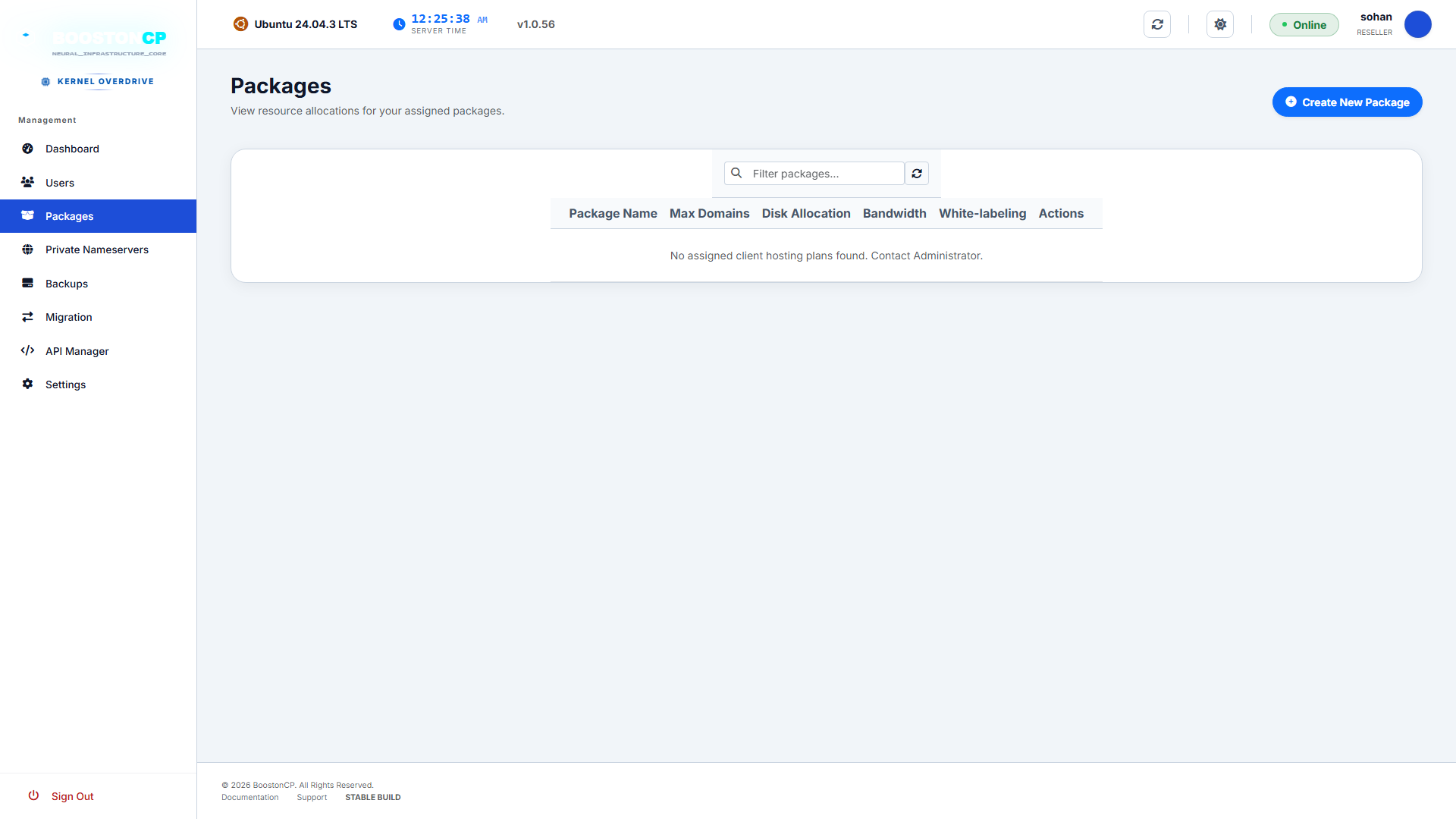
Predictable Hardware Economics: Configuring Unlimited Hosting Packages Without Vendor Royalty Fees
Chapter 5: The Stagnation of the Monolith (Why 20-Year-Old Codebases Rot)
When private equity firms extract massive capital out of software companies to service acquisition debt, where does that capital come from? It does not come from magical operational efficiencies. It comes from gutting engineering budgets, slashing Research & Development (R&D), outsourcing senior customer support to low-cost regional centers, and halting deep architectural rewrites.
While WebPros was raising prices by over 800%, what happened to the actual underlying technology of cPanel and Plesk?
The uncomfortable truth that every experienced Linux system administrator knows is that cPanel in 2026 is fundamentally still a 1990s monolithic architecture wrapped in modern cosmetic CSS:
The Legacy Technical Liabilities of the Monopolies:
-
Monolithic Perl & Archaic Internal Daemons (
cpsrvd):
Underneath the shiny "Jupiter" theme, cPanel remains heavily dependent on an enormous, complex labyrinth of Perl scripts and legacy compiled C binaries designed in an era before modern concurrency models existed. System maintenance operations still trigger heavy fork loops that cause unnecessary CPU spikes across shared hosting nodes. -
The 2GB Idle Memory Footprint:
Spin up a fresh, pristine instance of AlmaLinux or Rocky Linux, install cPanel/WHM, create zero websites, and runfree -m.
The server will typically report 1.8GB to 2.4GB of RAM consumed simply keeping the control panel's background daemons alive (cpsrvd, cphulkd, queueprocd, tailwatchd, clamd, spamd, cpanellogd).
On a $5 or $10/month cloud VPS, the control panel consumes 100% of the server's available memory before a single visitor ever hits a single webpage! -
Total Indifference to Modern Development Stacks:
The modern web does not live on Apache prefork and PHP 5.6 anymore. The modern web runs on compiled microservices, Next.js frontend rendering, Node.js edge APIs, Python FastAPI backends, Ruby on Rails, and Go applications. As highlighted in our blueprint for deploying Next.js 15, Node.js, and Python on a self-hosted VPS with PM2, developers are abandoning serverless traps in favor of high-performance VPS nodes. To run a Node.js or Python application on legacy control panels, administrators are forced to buy expensive add-on licenses (such as CloudLinux Python Selector or Phusion Passenger integrations) or manually wrestle with brittle reverse proxy configs that break every time the panel performs an automatic nightly update. -
Resistance to Modern Linux Kernel Primitives (cgroups v2):
Modern Linux kernels (kernels 5.x and 6.x) provide extraordinary, native resource isolation primitives built directly into the operating system: cgroups v2,systemdslice isolation, eBPF packet inspection, and native namespace sandboxing. Instead of natively implementing these free, high-performance kernel capabilities to protect servers from noisy neighbors—as detailed in our research on why native cgroups v2 makes paid CloudLinux OS licenses obsolete and how to prevent shared hosting CPU spikes without CloudLinux—the legacy ecosystem encouraged hosts to purchase yet another third-party commercial license—CloudLinux OS ($16 to $25/mo per server)—to perform basic CPU and memory capping! -
Cosmetic Innovation vs. Real Architectural Value:
Over the last six years, while WebPros extracted hundreds of millions of dollars from the hosting community, what were the headline features delivered?- The retirement of the beloved "Paper Lantern" theme in favor of the widely criticized, high-contrast "Jupiter" theme.
- Increased integration of telemetry and promotional upsell banners in the admin dashboard (pushing paid SSL certificates, paid backup services, and paid malware scanners).
- Renaming menu items and deprecating legacy features without modern replacements.
The hosting industry had reached a grotesque paradox: they were paying enterprise software prices for a decaying, legacy technology stack that was actively suffocating their server performance.
Chapter 6: The Economic Carnage — How the License Tax Crushed Web Agencies
The victims of the WebPros monopoly were not merely wealthy hosting corporations. The real victims were freelance developers, digital agencies, small-town web designers, and independent internet service providers across developing nations.
The Death of the Affordable Agency Hosting Model
For years, digital marketing and web development agencies generated predictable, recurring revenue through "Care Plans." An agency would build 40 WordPress websites for local dentists, contractors, and law firms, host them on a robust $40/month VPS, and charge each client $50/month for hosting, maintenance, and backups.
Under the traditional flat-rate licensing model, the agency's infrastructure expense was fixed:
- VPS Hardware: \$40/month
- cPanel VPS License: \$15/month
- Total Infrastructure Cost: \$55/month
- Gross Revenue from 40 Clients: \$2,000/month
- Net Margin: 97.25%
Now, examine what happened to that exact same agency under the per-account licensing regime, especially as they grew to 150 client sites across two servers:
- Two VPS Cloud Nodes: \$80/month
- Two cPanel Premier Licenses (100 accounts base): \$120/month
- 50 Additional Accounts Overage (\$0.39/each): \$19.50/month
- WHMCS Monthly Tiered Billing License: \$40/month
- Paid OS Resource Isolation (CloudLinux): \$32/month
- Paid Imunify360 Anti-Malware: \$30/month
- Total Monthly Software & Infrastructure Cost: \$321.50/month
- Annual Infrastructure Cost: \$3,858.00 / year (an increase of over \$3,000/year straight out of the agency owner's pocket).
                      THE AGENCY COST COMPARISON
  $4,000 ┬─────────────────────────────────────────────────────────────► $3,858/yr
         │                                                            (Monopoly Stack)
  $3,000 ┼
         │
  $2,000 ┼
         │
  $1,000 ┼                                      ► $480/yr
         │                                        (Autonomous Open Stack)
    $500 ┼────────► $660/yr
         │          (Pre-2019 Golden Era)
      $0 ┴──────────┴───────────────────────────┴──────────────────────►
                 2016                       Current Monopolies     Modern Open VPS
When web agencies saw their margins being systematically cannibalized, they were forced into an awful dilemma: either pass the price hikes onto small business clients who were already struggling during economic downturns, or absorb the compounding costs themselves and watch their businesses slowly wither.
Chapter 7: The Great Exodus — The Rise of the Autonomous Infrastructure
Every aggressive monopoly carries within itself the seeds of its own destruction. By pushing price hikes past the pain threshold of rational tolerance, WebPros did something that decades of open-source evangelism had failed to achieve: they made the status quo more terrifying than the risk of change.
Beginning in late 2023 and reaching full velocity in 2026, an unprecedented migration began. System administrators, infrastructure architects, and agency founders began actively de-platforming from the WebPros stack.
This movement is not simply about finding a "cheaper clone" of cPanel. It represents a fundamental paradigm shift toward Autonomous, High-Density, Native Linux Infrastructure.
The Architectural Blueprint of the Counter-Revolution
The new breed of infrastructure platforms—epitomized by BoostonCP—was engineered from the ground up to address every single structural failure of the legacy monopolistic era:
+-----------------------------------------------------------------------------------------+
|                  THE OLD MONOPOLY PARADIGM vs. THE BOOSTONCP PARADIGM                   |
+---------------------------------------------------+-------------------------------------+
| Legacy WebPros Stack (cPanel/Plesk/WHMCS)         | Modern Autonomous Stack (BoostonCP) |
+---------------------------------------------------+-------------------------------------+
| Per-Account Licensing Tax ($0.39/account/mo)      | Zero Per-Account Fees Forever       |
| Monolithic Perl / Archaic Forking Daemons         | Compiled Go / C High-Velocity Core  |
| 1.8GB - 2.5GB Idle RAM Overhead                   | < 280MB Idle RAM Footprint          |
| Forced Single Webserver (Rigid Apache/Nginx)     | 1-Click Multi-Webserver Switcher    |
| Paid CloudLinux OS Required for Resource Limits   | Native Linux Kernel cgroups v2      |
| Exposed Ports (2083, 2087, 80, 443 attack paths)  | Zero Open Ports (Cloudflare Tunnel) |
| Paid Imunify360 Required for Malware Defense      | Autonomous Sentinel Core Scanner    |
| Rigid Proprietary Backup Locks                    | Open Native Disaster Recovery S3/R2 |
+---------------------------------------------------+-------------------------------------+
Let us dissect the technical pillars that make this new generation of infrastructure untouchable by legacy monopolies:
1. Compiled Velocity vs. Scripted Bloat
Where legacy control panels execute thousands of lines of interpreted Perl and bash scripts to perform routine operations, BoostonCP executes via an ultra-fast compiled Go binary core located at /usr/bin/booston-core.
Operations that take 15 to 45 seconds in cPanel—such as provisioning a new virtual host, issuing a Let's Encrypt Wildcard SSL certificate, generating a DNS zone file, or creating an isolated Linux system user—execute in sub-50 milliseconds in BoostonCP. The entire background footprint is under 280MB of RAM, allowing web hosts to run hundreds of active websites on a simple $5 or $10 cloud VPS without breaking a sweat.
2. The $0 Native cgroups v2 Alternative to CloudLinux
For over a decade, shared hosting providers paid tens of thousands of dollars for CloudLinux OS solely to acquire the "LVE Manager"—a mechanism to prevent a single hacked or heavy WordPress site from consuming 100% of a server's CPU and RAM and crashing neighboring websites.
Modern Linux kernels possess this capability out-of-the-box through cgroups v2 (Control Groups Version 2).
BoostonCP directly interfaces with the Linux kernel's native cgroups v2 subsystem via systemd slices. Administrators can assign granular, hard resource boundaries per domain or per user directly from the graphical user interface:
$$\text{Memory Limit} = \text{memory.max} = 1073741824 \text{ (1 GB)}$$ $$\text{CPU Quota} = \text{cpu.max} = 100000 \text{ } 100000 \text{ (1 Full Core)}$$ $$\text{IOPS Throttle} = \text{io.max} = 8:0 \text{ } \text{rbps}=10485760 \text{ } \text{wbps}=10485760 \text{ (10 MB/s)}$$
When a rogue WordPress script hits its 1GB boundary, the Linux kernel gracefully throttles or terminates only the offending child worker in its isolated slice. Neighboring websites experience exactly 0% performance degradation. Total additional software licensing cost: exactly $0.00.
3. Domain-Level Webserver Freedom (Zero Downtime Switching)
In the legacy monopoly world, changing your web server stack is a high-risk server-wide catastrophe. If you run Apache and wish to switch to OpenLiteSpeed or Nginx, you must recompile EasyApache, wait 20 minutes, risk PHP module incompatibilities, and take down every website on the physical node during the process.
BoostonCP pioneered the Isolated Multi-Webserver Architecture:
- Host Nginx functions as the ultra-fast edge reverse proxy on ports 80 and 443, terminating SSL with HTTP/3 QUIC support.
- Behind the edge proxy, every single domain can independently select its own backend execution engine:
- Native Nginx + PHP-FPM: For blisteringly fast, low-overhead static and dynamic caching capable of mitigating Layer 7 DDoS and achieving sub-10ms TTFB with FastCGI microcaching.
- Apache 2.4 (Docker Isolated): For legacy applications that strictly mandate
.htaccessrewrite compatibility and custom Apache modules. - OpenLiteSpeed (Docker Isolated): For WooCommerce and heavy WordPress installations utilizing the LiteSpeed Cache plugin.
A hosting provider can switch a domain from Nginx to Apache to OpenLiteSpeed in under 1 second with zero downtime, without affecting any other customer on the server!
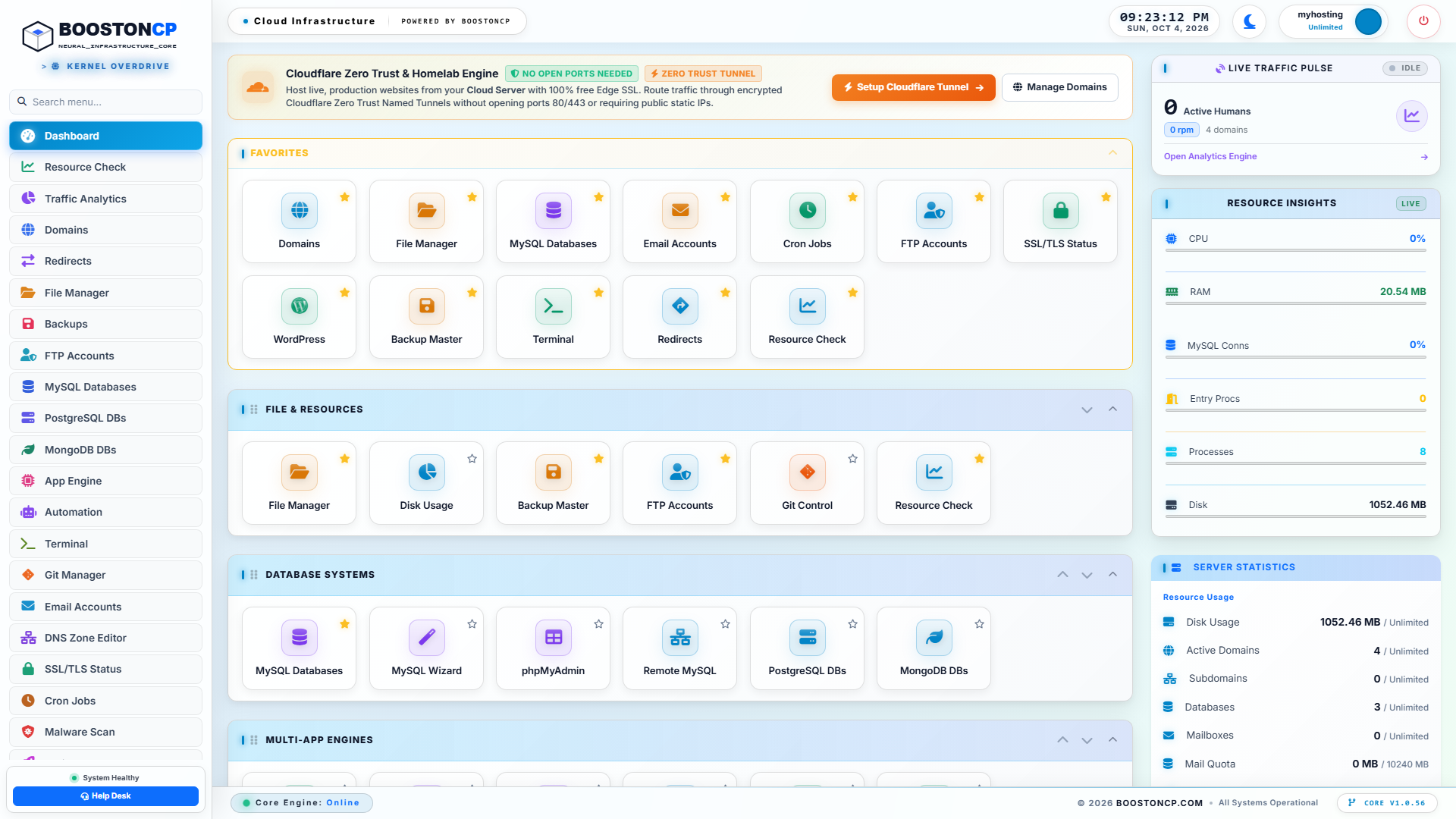
Next-Generation Cloud Control: Clean, Modern, and Free from 1990s Monolithic Bloat
4. Zero Open Ports & Edge Tunneling Hardening
Legacy hosting panels mandate that dozens of ports remain permanently exposed to the public internet:
- Port 2083 / 2087: cPanel / WHM Web Interface
- Port 80 / 443: HTTP / HTTPS Web Traffic
- Port 21: Plaintext FTP
- Port 25 / 465 / 587: SMTP Email
- Port 3306: MySQL Database
- Port 22: SSH Management
Every single open port is an attack vector subjected to 24/7 brute-force dictionary attacks, zero-day CVE exploits, and amplified DDoS attacks.
BoostonCP integrates the Zero Open Ports Paradigm via native Cloudflare Tunnel (cloudflared) orchestration. As broken down in our definitive guide to zero open ports VPS hosting with Cloudflare Tunnel, in this hardened architecture your firewall drops 100% of all inbound traffic on ports 80, 443, 2083, and 2087 (ufw default deny incoming). The server establishes an outbound, encrypted QUIC tunnel directly to Cloudflare's global edge network.
Your server's true origin IP address is mathematically untraceable. Layer 7 DDoS attacks, botnet scrapers, and port scanners hit Cloudflare's global edge and are dropped before a single packet ever reaches your Linux VPS.
Chapter 8: The Comprehensive Financial Audit (500 Accounts over 5 Years)
To illustrate the sheer scale of wealth extraction orchestrated by the private equity monopoly, let us perform a rigorous financial audit.
We will model a growing web hosting company or regional digital agency managing 500 client websites. We will compare their total software licensing costs over a 5-year operational horizon between the legacy WebPros monopoly stack and an autonomous modern platform like BoostonCP.
Scenario A: The Legacy WebPros Monopoly Stack (500 Accounts)
To host 500 accounts professionally under the WebPros ecosystem across two robust dedicated nodes (250 accounts per server), a hosting provider must purchase:
- cPanel Premier Licenses (2 Servers): Base 100 accounts included per server = \$60/mo × 2 = \$120/mo.
- cPanel Account Overages: 150 extra accounts per server = 300 extra accounts × \$0.39/each = \$117/mo.
- CloudLinux OS Licenses (2 Servers): \$16/mo × 2 = \$32/mo (required to stop noisy neighbors).
- Imunify360 Malware Security (2 Servers): \$30/mo × 2 = \$60/mo (required for automated malware cleaning).
- WHMCS Business Tier License: Up to 500 active clients = \$40/mo.
- Compounding Annual Price Increases: We will conservatively model an average 10% annual price hike (well below historical PE averages).
Year-by-Year Cash Outflow (WebPros Stack):
- Year 1: \$369.00 / month = \$4,428.00
- Year 2 (10% hike): \$405.90 / month = \$4,870.80
- Year 3 (10% hike): \$446.49 / month = \$5,357.88
- Year 4 (10% hike): \$491.14 / month = \$5,893.67
- Year 5 (10% hike): \$540.25 / month = \$6,483.04
- TOTAL 5-YEAR SOFTWARE LICENSE EXTORTION: \$27,033.39 USD
Scenario B: The Autonomous BoostonCP Stack (500 Accounts)
Now, let us examine the exact same 500 client accounts deployed on the same physical hardware utilizing BoostonCP's autonomous architecture:
- BoostonCP Core License: \$0.00 (Unlimited domains, unlimited accounts, and full multi-database architecture support for MariaDB, PostgreSQL, MongoDB, and Redis forever).
- Resource Isolation: Native Linux Kernel cgroups v2 = \$0.00 (Built directly into the OS).
- Malware Defense: Autonomous Sentinel Engine = \$0.00 (Read our benchmark on high-performance Linux malware scanning under 300MB RAM without paying for Imunify360).
- Billing & Provisioning: Open API integration / Flat-rate modern billing = \$0.00 per-account tax.
- Annual Compounding Increases: \$0.00.
Year-by-Year Cash Outflow (BoostonCP Stack):
- Year 1: \$0.00
- Year 2: \$0.00
- Year 3: \$0.00
- Year 4: \$0.00
- Year 5: \$0.00
- TOTAL 5-YEAR SOFTWARE LICENSE EXPENSE: \$0.00 USD
The Executive Economic Verdict
| Metric | Legacy WebPros Monopoly Stack | Autonomous BoostonCP Stack | Net Business Savings with BoostonCP |
|---|---|---|---|
| 5-Year Software License Bill | \$27,033.39 | \$0.00 | +\$27,033.39 Direct Profit |
| Per-Account Incremental Penalty | \$0.39 / account / mo | \$0.00 (Zero Tax) | 100% Margin Retention |
| RAM Consumed by Idle Panels | ~4.8 GB across nodes | < 600 MB total | 87.5% Memory Freed for Clients |
| Vendor Dependency Risk | Extreme (Boardroom Price Hikes) | Zero (Sovereign Linux Node) | Complete Strategic Immunity |
$$\text{Net 5-Year Capital Preserved} = \mathbf{\$27,033.39 \text{ USD}}$$
Think about what an independent hosting business, agency, or developer can do with an extra $27,000 in retained capital:
- Hire another full-time software engineer or senior support specialist.
- Invest $450/month into targeted Google Ads or sponsor developer podcasts to acquire hundreds of new clients.
- Upgrade every single server node from modest budget CPUs to enterprise AMD EPYC 9004 processors with Gen5 NVMe arrays.
- Pocket the cash as pure, unadulterated founder distributions.
Paying a private equity monopoly for software that actively degrades your server performance is no longer just bad technical hygiene—it is gross financial negligence.
Chapter 9: The Playbook for Liberation — How to Migrate Away from the Monopoly
The greatest psychological weapon WebPros possesses is the myth that migrating away from cPanel is impossible.
The reality in 2026 is that modern automation tools have reduced migration friction to an automated background task. Here is the step-by-step strategic roadmap that hundreds of web hosting companies and agencies are using right now to liberate their infrastructure:
+------------------------------------------------------------------------------------------+
|                          THE 4-STAGE MIGRATION TO FREEDOM                                |
|                                                                                          |
| [1. Audit & Inventory] ──► [2. Deploy Standby Node] ──► [3. Automated Sync] ──► [4. Cutover]|
|   - Triage accounts          - Install BoostonCP          - Extract cpmove         - Zero TTL    |
|   - Catalog databases        - Zero-Port Tunnel           - MySQL & Mail sync      - Seamless DNS|
+------------------------------------------------------------------------------------------+
Step 1: Deploy a Parallel Autonomous Server Node
Never attempt an in-place destructive migration on a live production server. Spin up a fresh, high-performance cloud VPS or dedicated server running Ubuntu 22.04/24.04 or Debian 12.
Install the modern autonomous control environment in under 5 minutes. The compiled Go core installs cleanly with zero bloat:
# Verify clean OS baseline and deploy high-performance compiled core
curl -sSL https://get.boostoncp.com/install.sh | bash
Once installed, navigate to the unified, responsive dashboard at https://your-server-ip:2087 (or via your secure Cloudflare Tunnel domain).
Step 2: Automated Ingestion of Legacy cPanel Backups (cpmove)
BoostonCP features a built-in, automated migration engine specifically engineered to deconstruct and translate proprietary cPanel archives into clean, native Linux virtual hosts:
- On your legacy cPanel/WHM server, generate full account backups using the standard command-line utility or WHM backup wizard:
/scripts/pkgacct/backup/ - Transfer the resulting
cpmove-archives to your new BoostonCP server via high-speed.tar.gz rsyncor SFTP:rsync -avz -e "ssh -p 22" /backup/cpmove-*.tar.gz root@new-node.yourdomain.com:/var/backups/migrations/ - In the BoostonCP Admin Dashboard, navigate to Migrations & Ingestion:
- Select 1-Click cPanel Backup Restore.
- The automated engine parses the archive, provisions the isolated Linux system user, creates the isolated cgroups v2 resource slice, restores all MySQL/MariaDB databases, sets proper user permissions, provisions mailboxes with DKIM/SPF configurations, and builds the Nginx edge vhost configuration.
- Total time per standard WordPress site: Under 12 seconds. (For a deeper technical walkthrough of large-scale hosting migrations, review our zero-downtime cPanel migration blueprint for web hosts, and learn how to run zero-risk WordPress staging and 1-click production sync before cutting over live production traffic).
Step 3: Zero-Downtime Database & Mailbox Final Sync
To guarantee that not a single customer email or WooCommerce database transaction is lost:
- Lower your DNS Time-to-Live (TTL) on your domains to 300 seconds (5 minutes) 24 hours prior to the migration cutover.
- Put the legacy cPanel site into maintenance mode or run a final differential
rsyncof the database dump:# Differential database synchronizer mysqldump --single-transaction| ssh root@new-node "mysql " - Run an automated IMAP synchronization tool (such as
imapsync) to catch any emails delivered during the propagation window.
Step 4: The Final DNS Cutover
Point your domain's A-record or Cloudflare proxy to the new BoostonCP server IP or tunnel route.
Because BoostonCP automatically issues Let's Encrypt Wildcard SSL certificates the instant a virtual host is provisioned, your visitors never see an SSL warning, never experience a 502 Bad Gateway, and never know that their website was transitioned from a 25-year-old legacy Perl monolith to an ultra-modern compiled cloud infrastructure.
The migration is complete. The private equity handcuffs are broken.
Chapter 10: Epilogue — Reclaiming the Open Web
The internet was never supposed to be an asset portfolio managed by private equity financiers in Zurich and London. It was built by visionaries, open-source contributors, independent hackers, and daring entrepreneurs who believed that communication, computing, and commerce should be democratized for every human being on the planet.
When monopolies acquire the public squares and infrastructure tools of the digital world, they inevitably turn what was once a creative canvas into an extractive toll booth. They bet on your inertia. They bet that you are too tired, too intimidated, or too busy to fight back.
Every dollar you send to a private equity software monopoly is a dollar taken away from your engineering, a dollar taken away from your customer support, and a vote for the continued financialization and stagnation of the global web.
The tools for total digital sovereignty now exist. They are faster, lighter, more secure, and mathematically immune to per-account licensing extortion.
The era of digital hostage-taking is over. It is time to take back your servers.
Ready to Experience Total Infrastructure Freedom?
Stop paying compounding software license taxes on hardware you already own. Test the future of autonomous, high-density web hosting today:
👉 Launch the Live Interactive BoostonCP Demo Environment (1-Click Instant Access)
Experience compiled sub-50ms execution speed, 1-second zero-downtime webserver switching, native Linux cgroups v2 resource capping, and zero per-account licensing fees forever.