Executive Summary
For over a decade, web hosting providers have been forced to pay a "Software Tax" of $14+ per month per server for CloudLinux. The reason? Legacy control panels like cPanel and Plesk lacked native mechanisms to prevent a single hacked WordPress site from crashing an entire server. In 2026, the modern Linux kernel features built-in, zero-cost cgroups v2 and systemd slices, rendering third-party LVE (Lightweight Virtual Environment) licenses technically obsolete. This exhaustive guide explores the architecture of native resource isolation and how BoostonCP engineers hardware-level sandboxing without the artificial licensing fees.
If you are a SysAdmin, a DevOps engineer, or a Web Hosting CEO, you are intimately familiar with the "Noisy Neighbor" crisis. You provision a powerful 64-core, 128GB RAM bare-metal server, load it with 300 shared hosting accounts, and sleep soundly. At 3:00 AM, a single poorly coded WordPress plugin on one client's site gets stuck in an infinite PHP loop.
Suddenly, the CPU spikes to 100%. RAM is exhausted. MySQL connections drop. The server crashes, taking all 300 innocent websites offline with it. This nightmare scenario is exactly why the web hosting industry surrendered to CloudLinux.
To solve the high CPU usage crisis and prevent mass outages, hosting providers have traditionally relied on CloudLinux's LVE Manager. It promised a simple solution: limit the CPU, RAM, and I/O per user. But in 2026, paying for a third-party OS patch to achieve basic resource isolation is not just a financial drain—it is an architectural paradox. Let's dive deep into why cgroups v2 limits are the ultimate CloudLinux alternative and how you can reclaim your server's profit margins.
The Archaic Nature of the "CloudLinux Tax"
To understand why a CloudLinux alternative in 2026 is critical, we must look at the history of Linux kernels. A decade ago, operating systems like CentOS 6 and CentOS 7 had very primitive tools for governing user resources. Legacy control panels (such as cPanel, Plesk, and DirectAdmin) were built on top of these older architectures.
Because the base OS couldn't safely sandbox users, CloudLinux stepped in. They developed LVE (Lightweight Virtual Environment), a custom kernel patch that acted as a referee, allocating strict limits to users. While revolutionary at the time, it came with a steep price: recurring monthly licensing fees per server.
Fast forward to today. The modern Linux kernel (powering Ubuntu 22.04/24.04 and Debian 12) has undergone a massive evolution. The kernel now natively includes cgroups v2 (Control Groups) and systemd orchestration. The operating system itself is now fully capable of hardware-level isolation. Yet, because legacy panels are bogged down by decades of technical debt, they cannot easily integrate with native cgroups v2. They remain dependent on CloudLinux, forcing you to pay for a feature that your server's kernel already provides for free.
The Native Solution: cgroups v2 and systemd Slices
When searching for a genuine lve limits alternative, the answer lies directly in the Linux Kernel. Control Groups (cgroups) are a Linux kernel feature that limits, accounts for, and isolates the resource usage (CPU, memory, disk I/O, network) of a collection of processes. Version 2 of cgroups brought a unified hierarchy, making it vastly more efficient and stable than older implementations.
Through systemd, these cgroups are manifested as "slices". Rather than relying on a proprietary third-party software patch, a modern control panel can instruct the Linux kernel directly to create a dedicated slice for every single hosting account.
root@server:~# cat /sys/fs/cgroup/user.slice/user-1001.slice/cpu.max
100000 100000
root@server:~# cat /sys/fs/cgroup/user.slice/user-1001.slice/memory.max
1073741824 # 1GB RAM strict hard-cap
By leveraging MemoryMax, CPUQuota, and IOReadBandwidthMax within these native systemd slices, a SysAdmin achieves the exact same (if not better) noisy neighbor protection as CloudLinux, but entirely within the native OS layer.
How BoostonCP Engineers Ultimate Resource Isolation
BoostonCP was engineered from day one for the modern Linux era. Recognizing the power of cgroups v2, BoostonCP completely eliminates the need for CloudLinux, offering the ultimate how to migrate from cPanel because of high CPU usage fix. Here is the technical breakdown of how BoostonCP's architecture protects your server natively.
1. Hardware-Level Systemd Slices per User
When a new hosting account (Standard User or Reseller) is provisioned in BoostonCP, the core engine dynamically creates a dedicated user-UID.slice systemd configuration. Every process spawned by that user—whether it is a PHP script, a database query, or a cron job—is trapped within this slice.
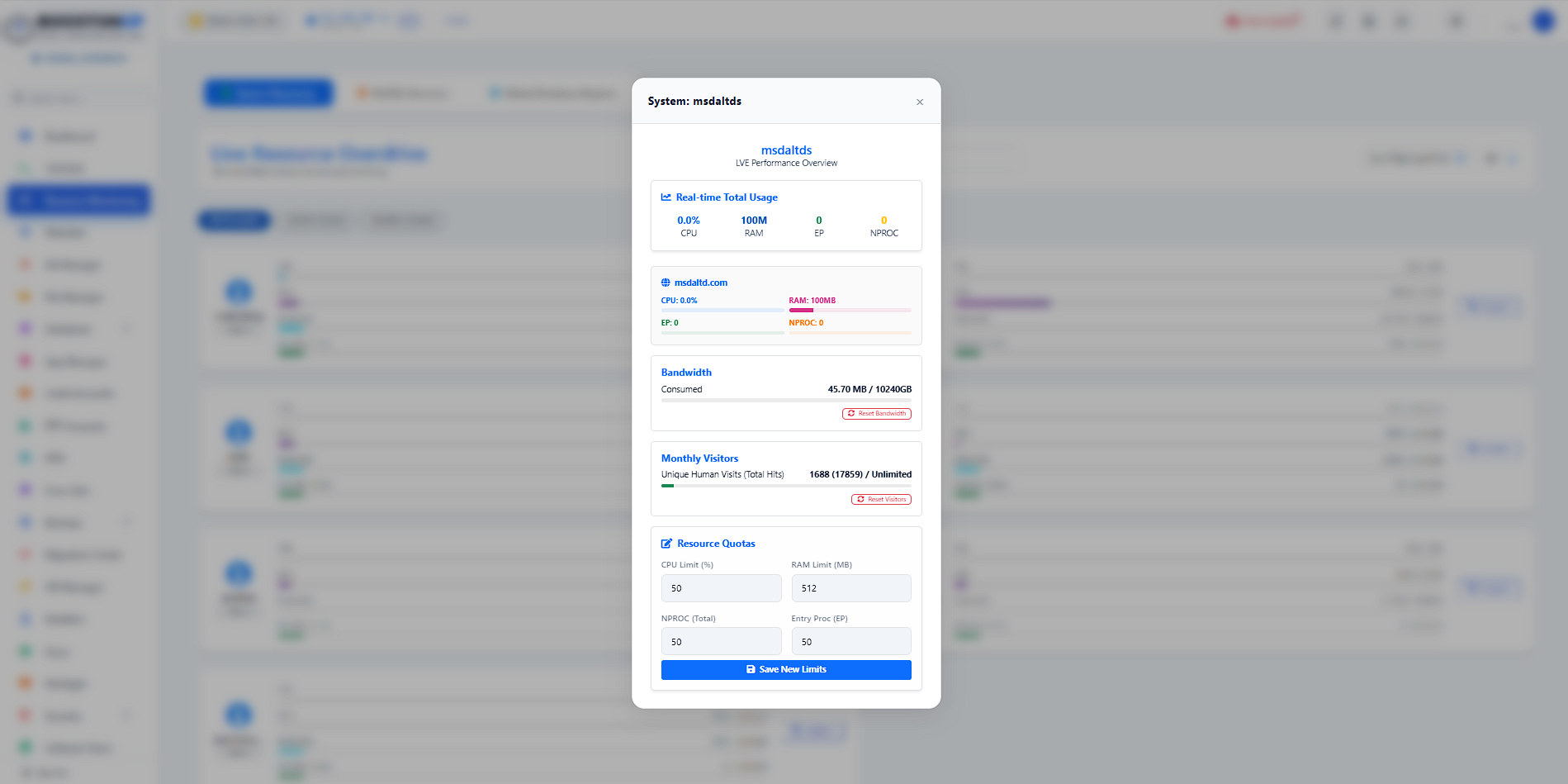
If the user is assigned a 1 Core CPU limit and 1GB RAM limit, the Linux kernel enforces this at the hardware scheduler level. If their WordPress site is attacked, they will hit their specific MemoryMax ceiling and their processes will be throttled or OOM-killed locally, while the rest of the server remains at 0% load.
2. Total Transparency: Real-Time Live Telemetry (Zero Support Tickets)
One of the biggest hidden costs of hosting is technical support. In a CloudLinux environment, users rarely have a clear, real-time understanding of why their website is slow. They open support tickets complaining about "server lag," forcing your admins to manually investigate, only to discover the user's WordPress site is hitting their LVE limits.
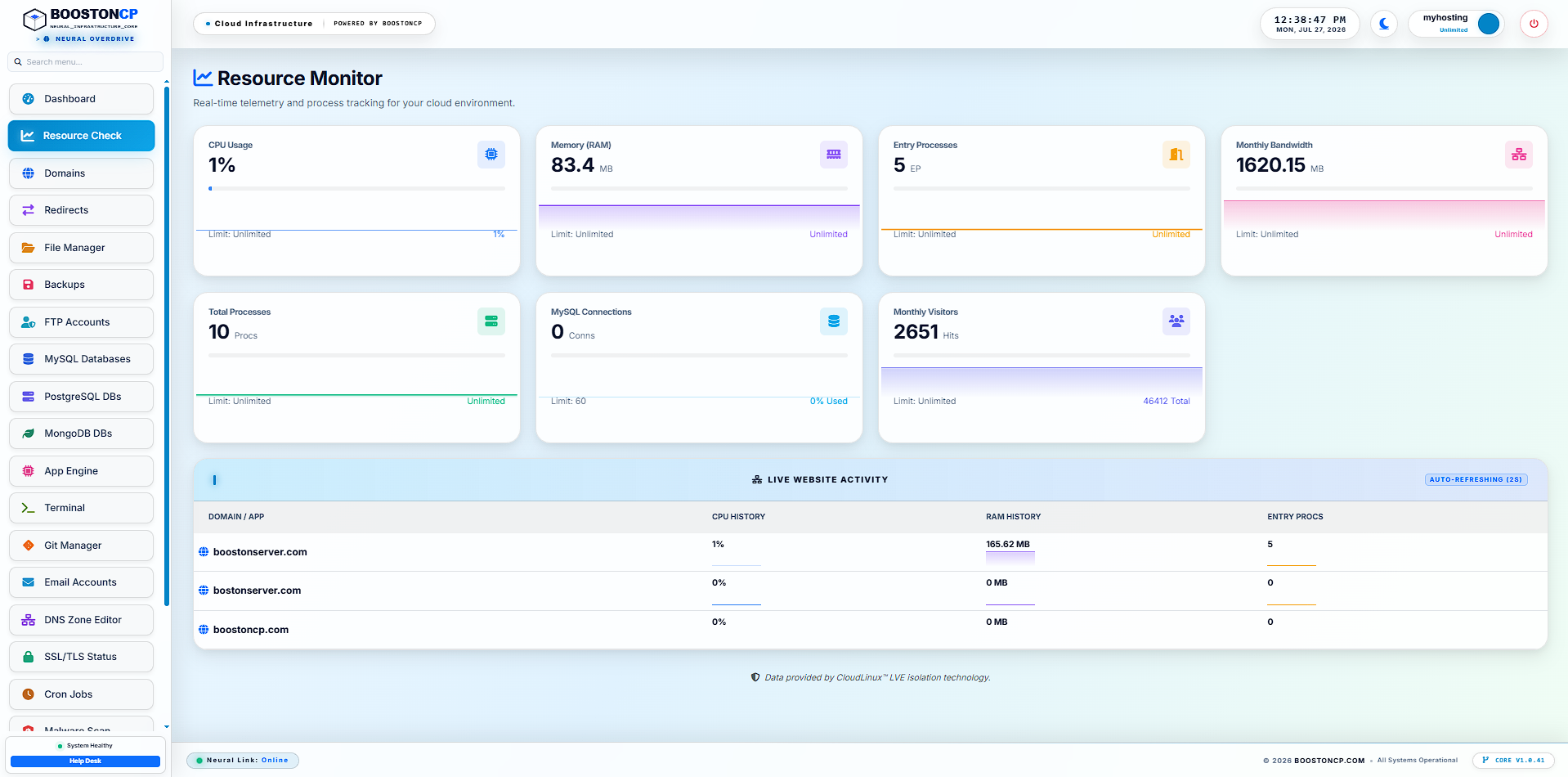
BoostonCP eliminates this "extra pera" (headache) entirely by providing Live Resource Overdrive Telemetry to both the Admin and the End-User:
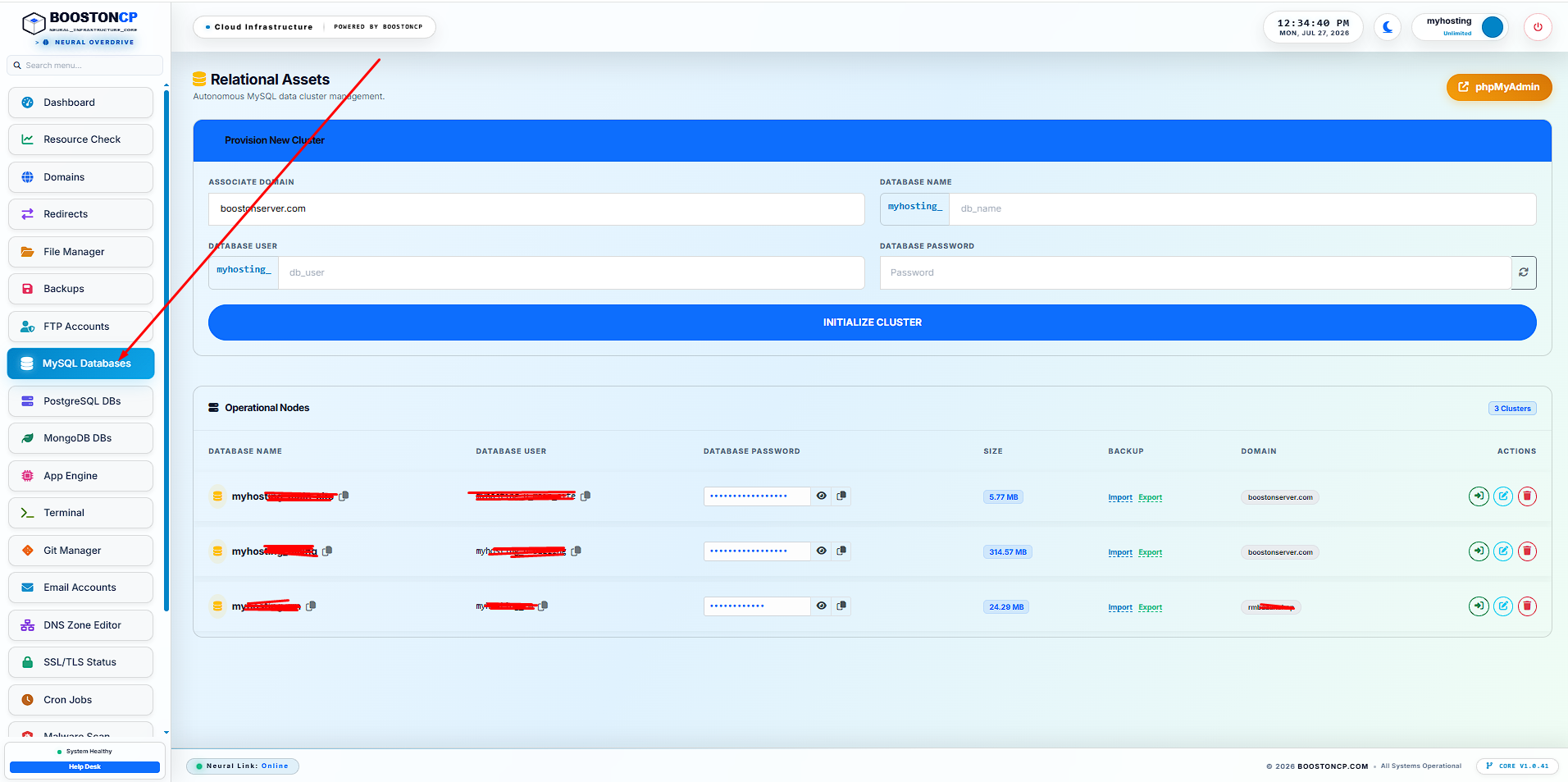
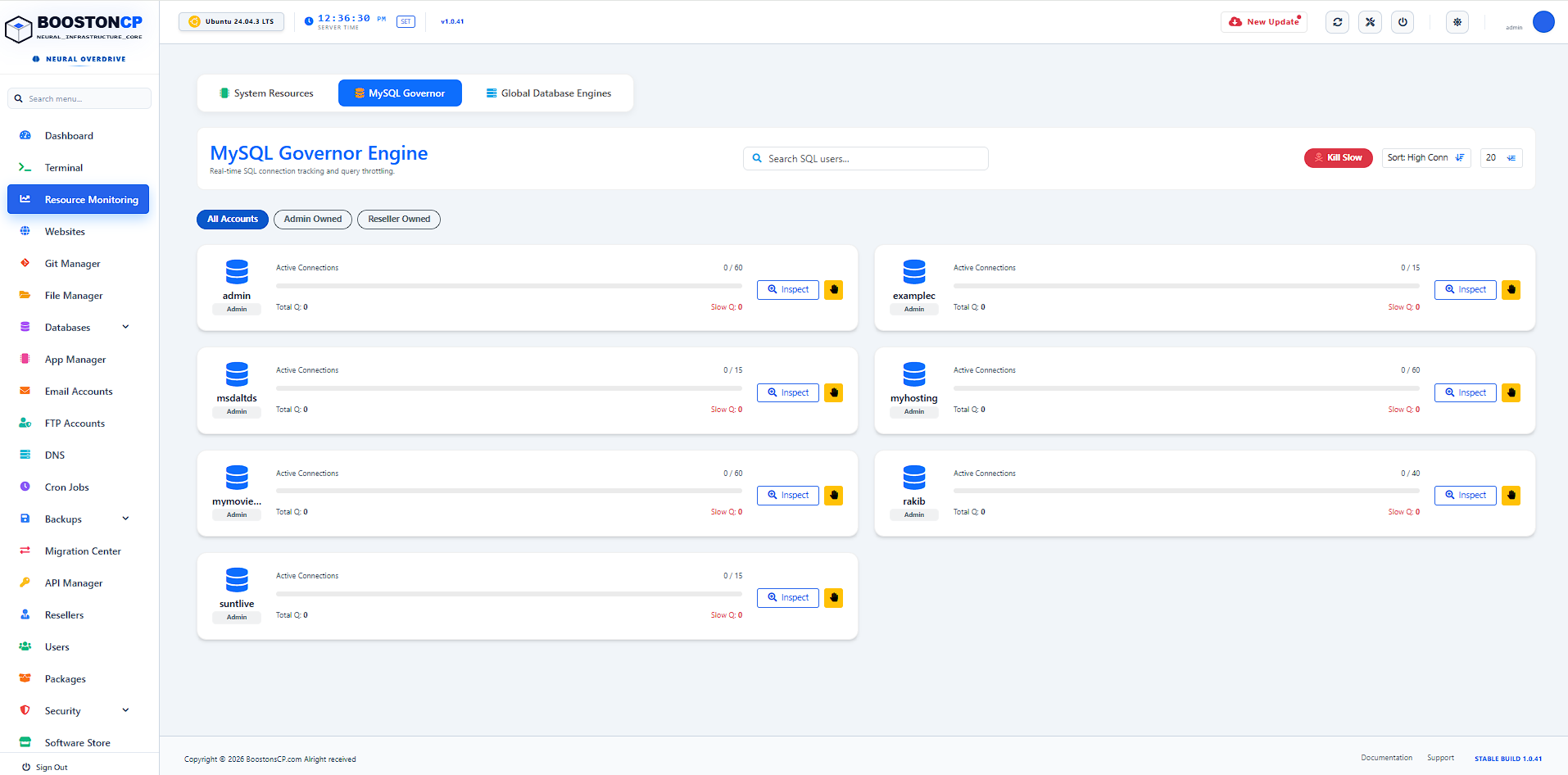
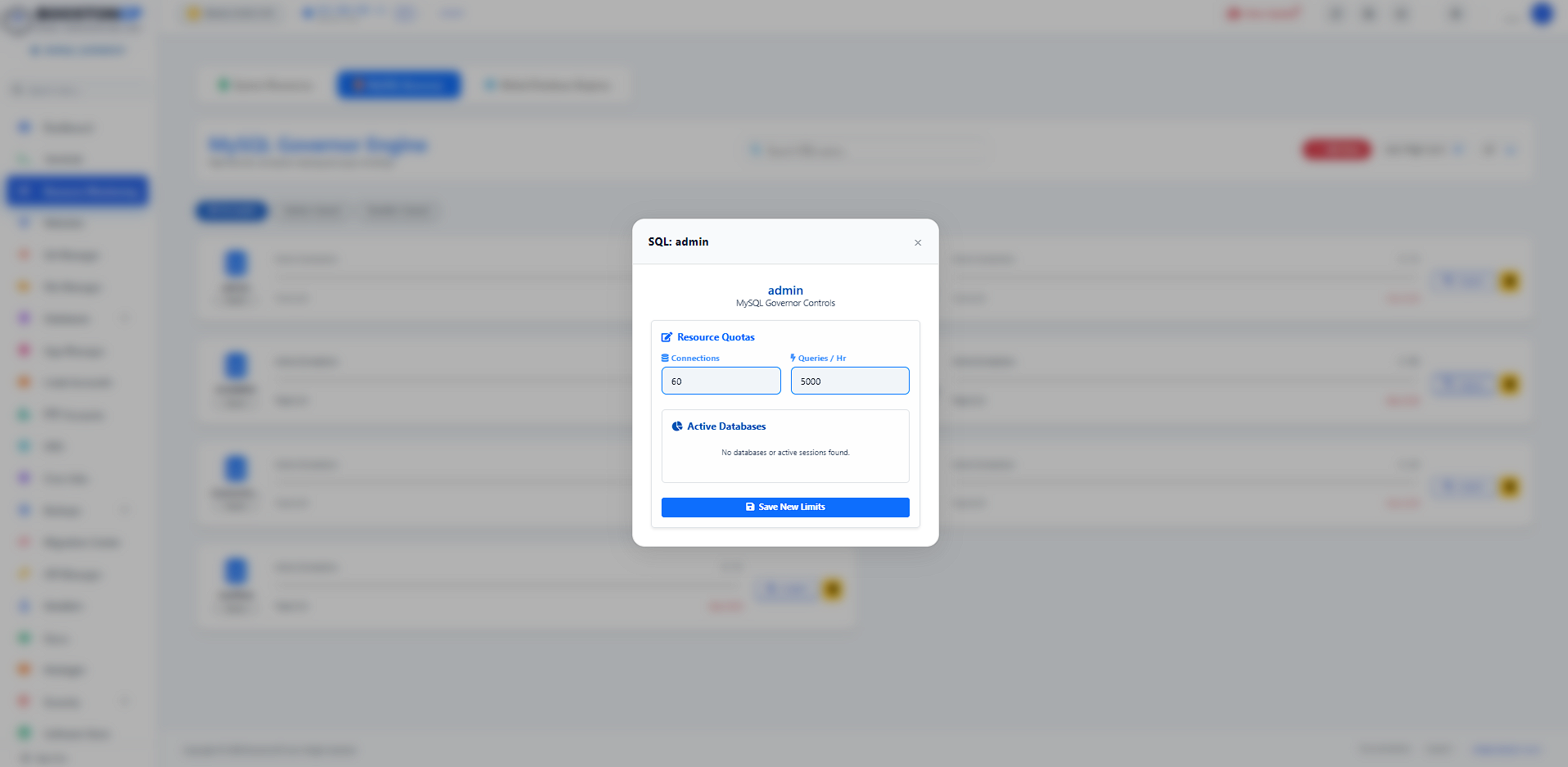
- The Admin View (Global Grid & MySQL Governor): Admins get a stunning grid interface displaying real-time CPU, RAM, and database loads across the entire server. Crucially, BoostonCP includes a built-in MySQL Governor Engine (a direct replacement for CloudLinux's MySQL Governor) that tracks real-time SQL connection spikes and allows the admin to instantly kill slow queries or throttle abusive database users. High-load users flash with a dynamic red pulse warning (pulse-red animation), preventing server-wide database crashes.
- The User View (Total Freedom): End-users have a massive, detailed "Resource Monitor" directly in their dashboard. They can track CPU, RAM, Entry Processes, MySQL Connections, and Bandwidth in real-time. Moreover, the "Live Website Activity" grid breaks down their usage per-domain. When their site slows down due to high traffic, they can instantly see their CPU or RAM bar hitting the 100% mark. Instead of opening a support ticket, they realize they need to upgrade their package or optimize their code.
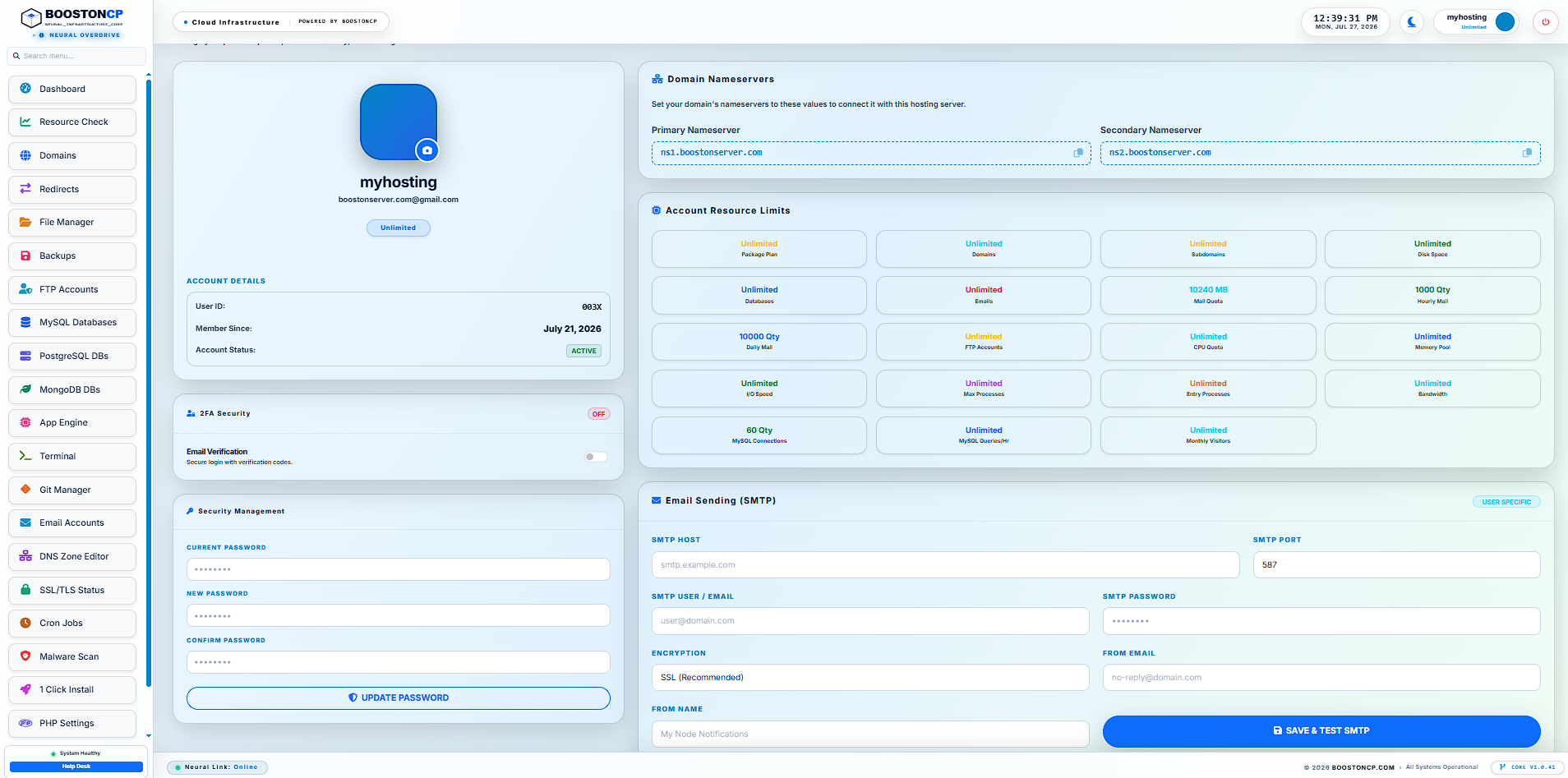
- Transparent Profile Limits: Users can visit their Account Profile to see exactly what limits their hosting package provides (e.g., CPU Quota, Memory Pool, IO Speed, MySQL Queries/Hr), fostering complete trust between the host and the client.
This level of architectural transparency shifts the responsibility from the host to the user, drastically reducing support overhead.
3. The App Engine Cage: Node.js and Python Isolation
Resource isolation is not just for PHP anymore. Modern developers require Node.js, Next.js, Ruby, and Python application hosting. In legacy environments, running a rogue Node.js or Ruby app could bypass PHP limits and consume massive memory.
BoostonCP solves this natively. When a user deploys a Python app (via a dynamically generated venv) or a Node.js/Ruby app (daemonized via PM2), the process executor is bound to the exact same systemd slice as the user's web environment. The cgroups v2 limits flawlessly govern background daemons just as strictly as web requests.
4. Advanced PHP Extension Management & Sandboxing (CloudLinux Style)
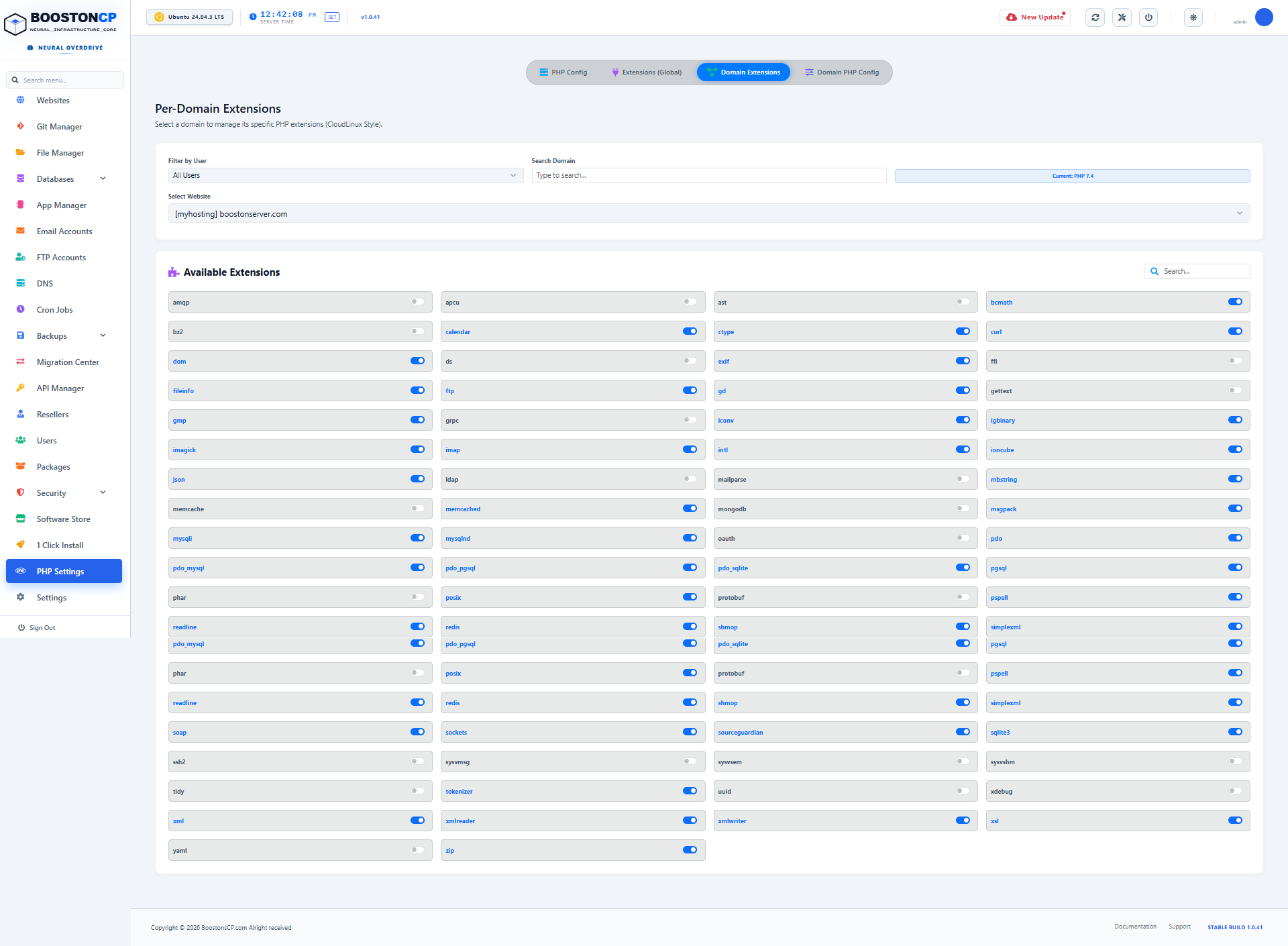
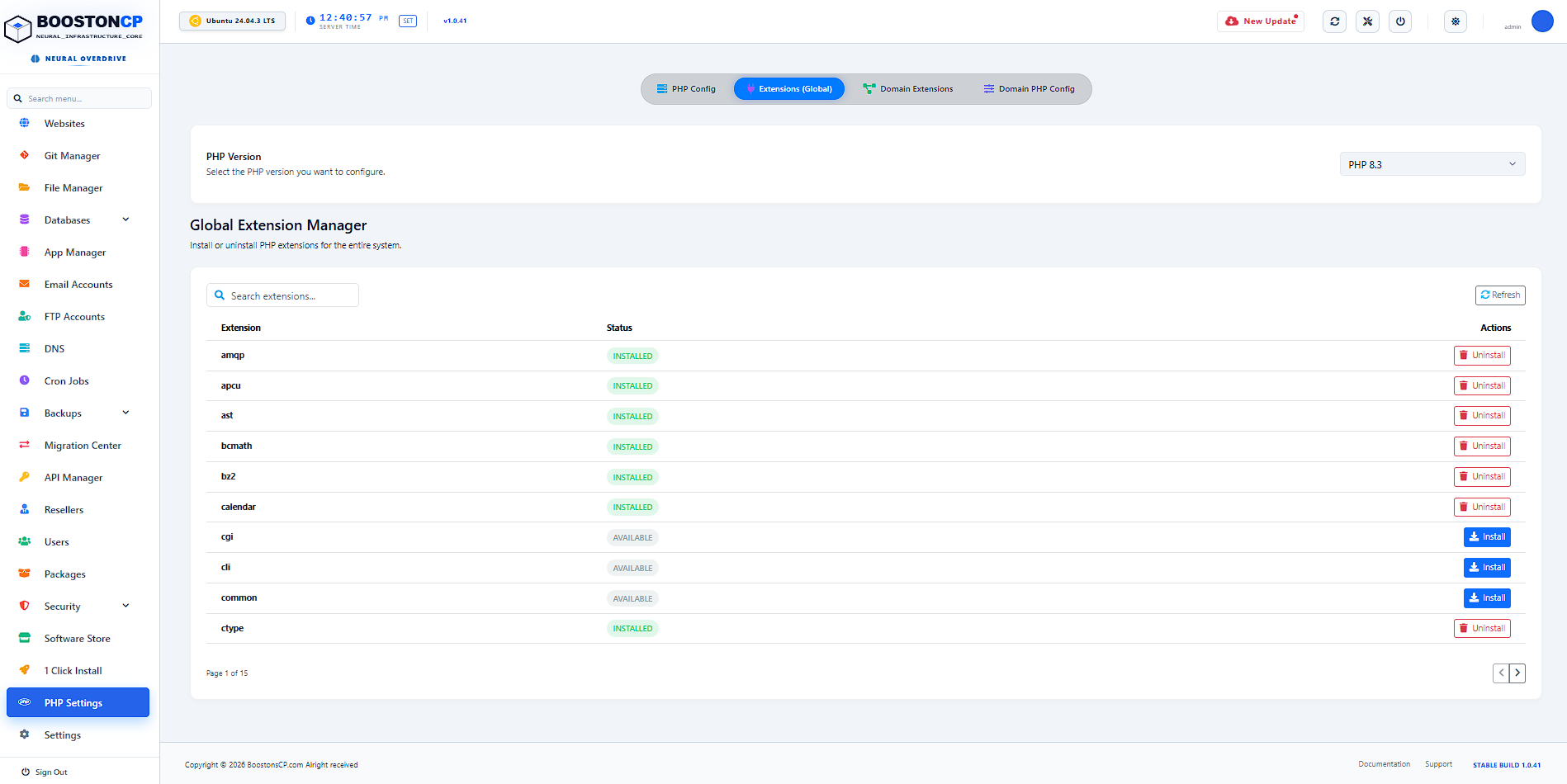
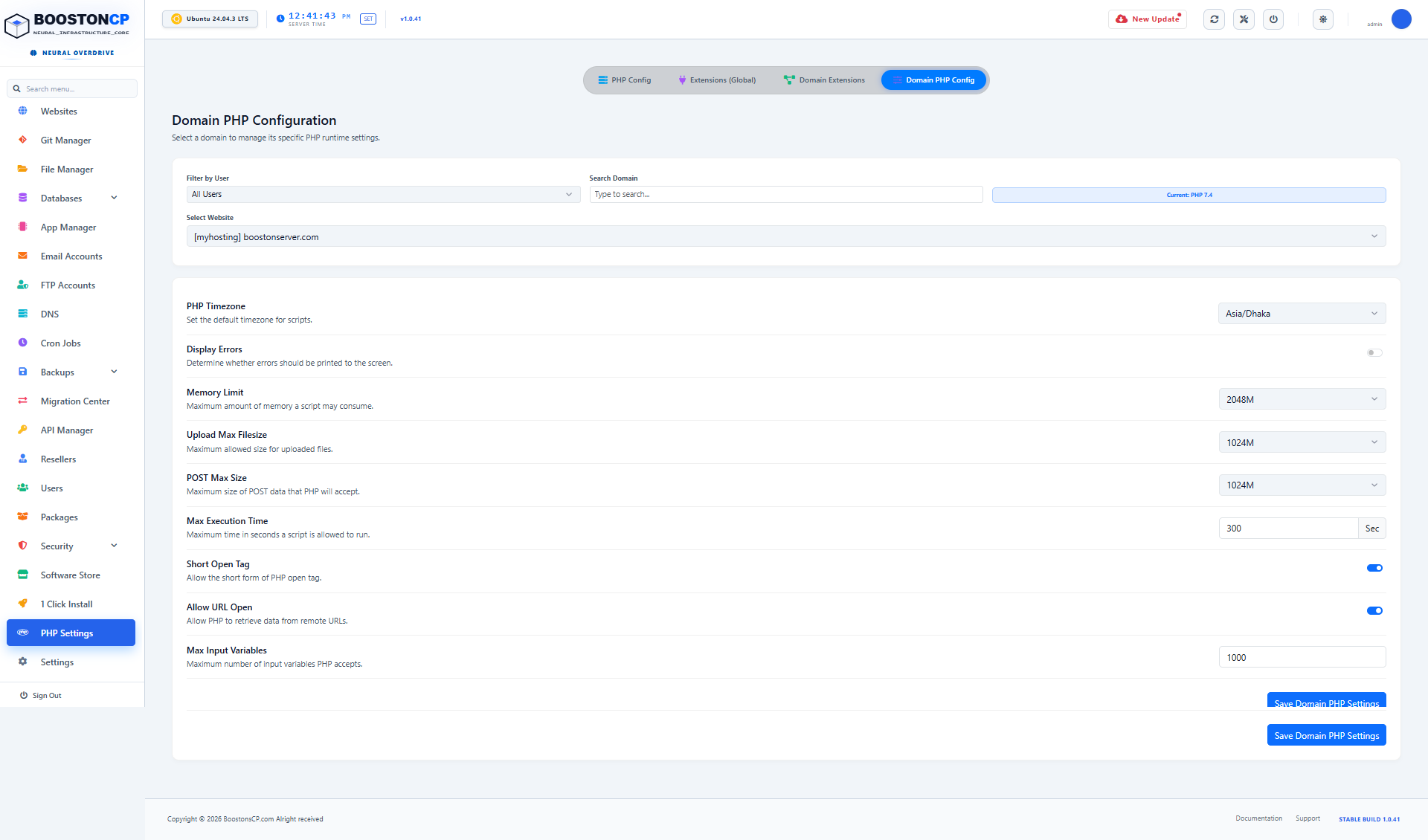
Unlike archaic setups that load global PHP modules for all users, BoostonCP provisions dedicated PHP configuration directories. But it goes a step further than traditional panels by offering true "CloudLinux Style" Per-Domain PHP Configuration.
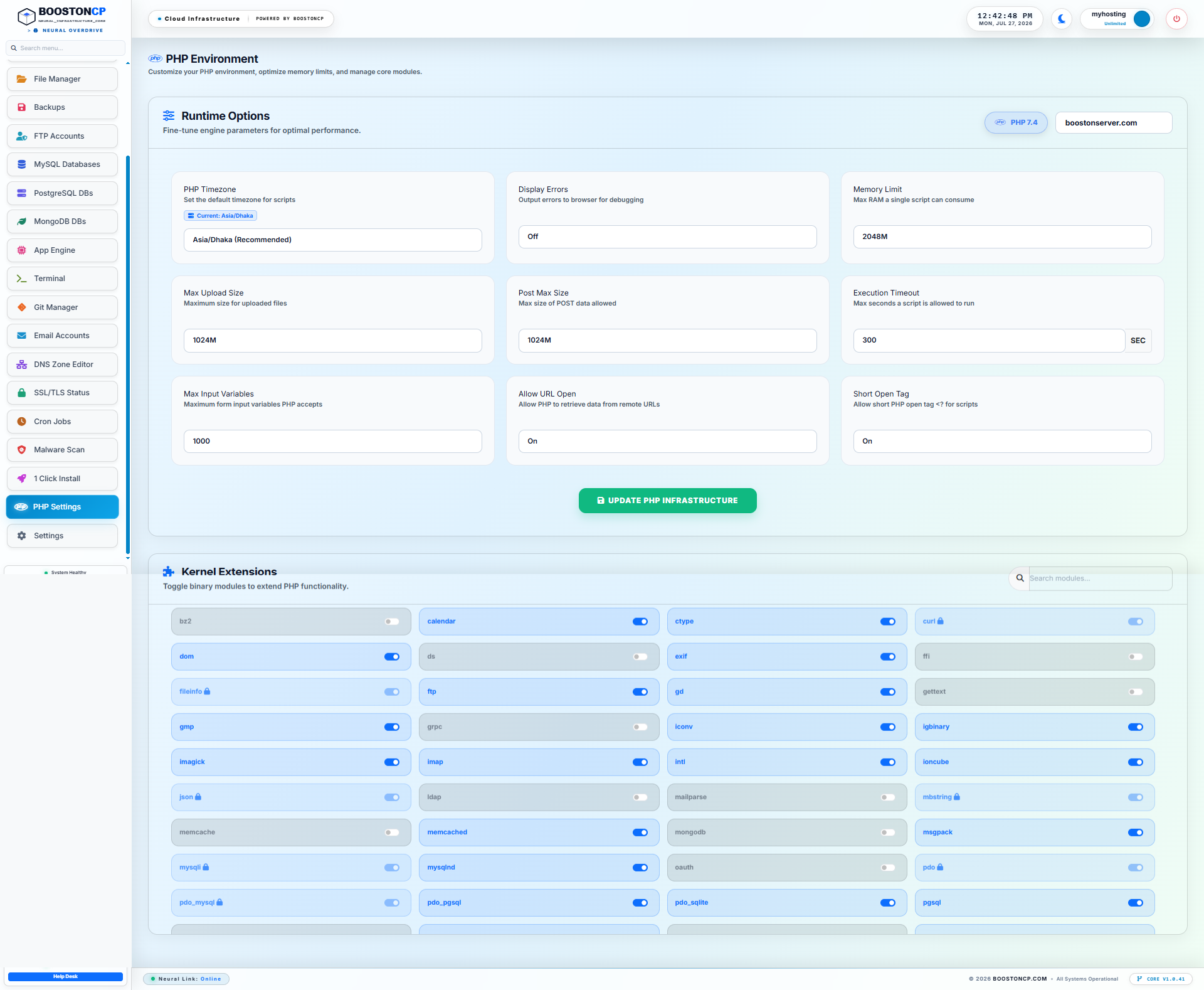
With BoostonCP, administrators have granular control over both Global Extensions and Domain-Level Extensions. More importantly, this absolute freedom is handed directly to the End-User. A user can log into their panel and instantly toggle Kernel Extensions (like imagick or redis) or adjust their Runtime Options (e.g., Memory Limit: 2048M) for a specific domain, without opening a support ticket. Each user environment receives tailored symlinks to extensions, ensuring complete separation of concerns and entirely eliminating the need for CloudLinux's PHP Selector.
Furthermore, secure environments are reinforced using advanced sandboxing concepts similar to bubblewrap, ensuring that even if an attacker gains terminal access (via the Secure Jailshell), their vision and reach are strictly confined to their own web root.
5. Complete Ecosystem: Replacing CageFS and Imunify360
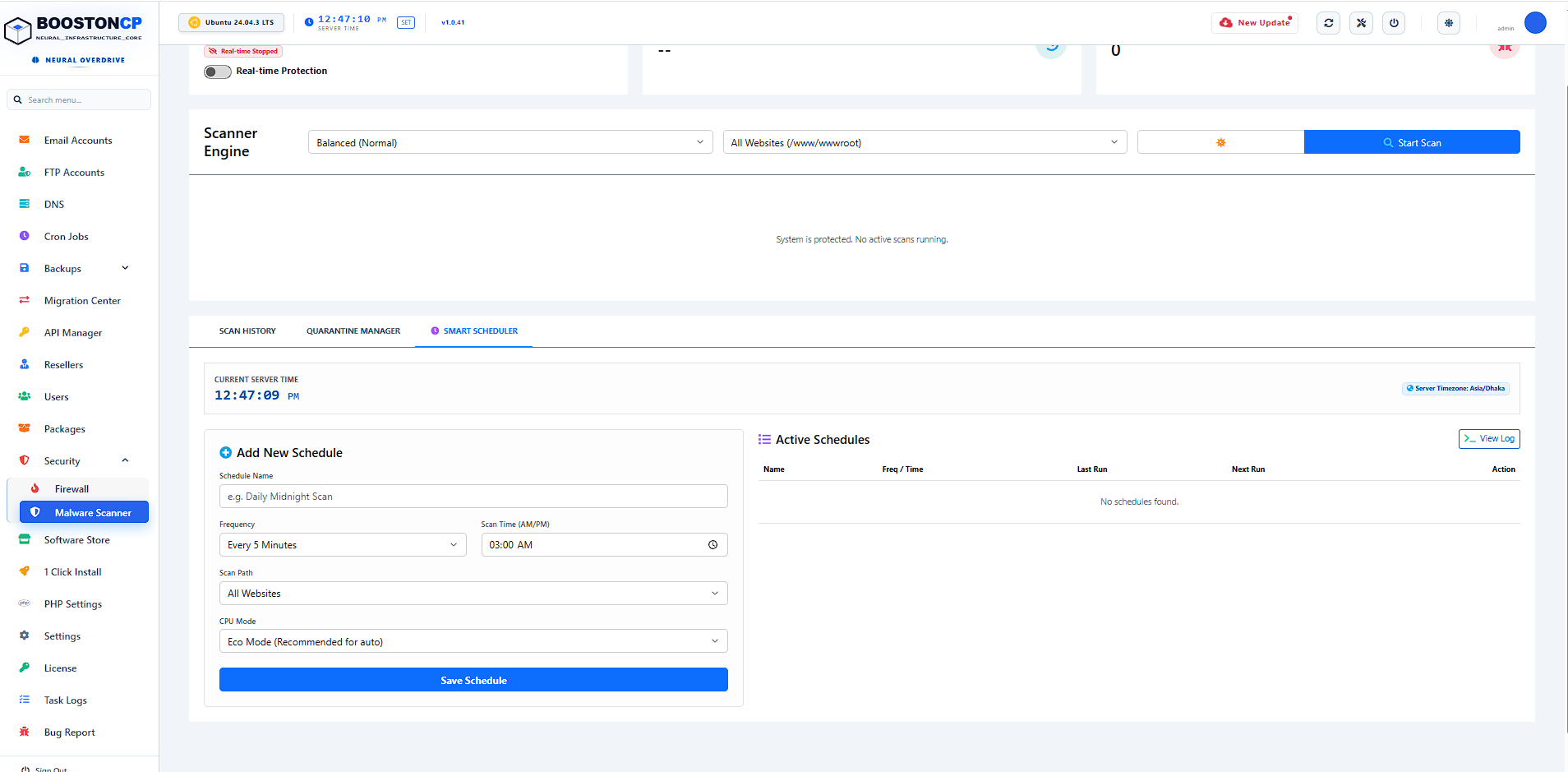
Resource limits alone do not replace CloudLinux; security is the other half of the equation. CloudLinux users are heavily dependent on CageFS (for filesystem isolation) and are often forced into expensive subscriptions for Imunify360 (for malware and firewall protection). BoostonCP replaces both out-of-the-box at zero additional cost.
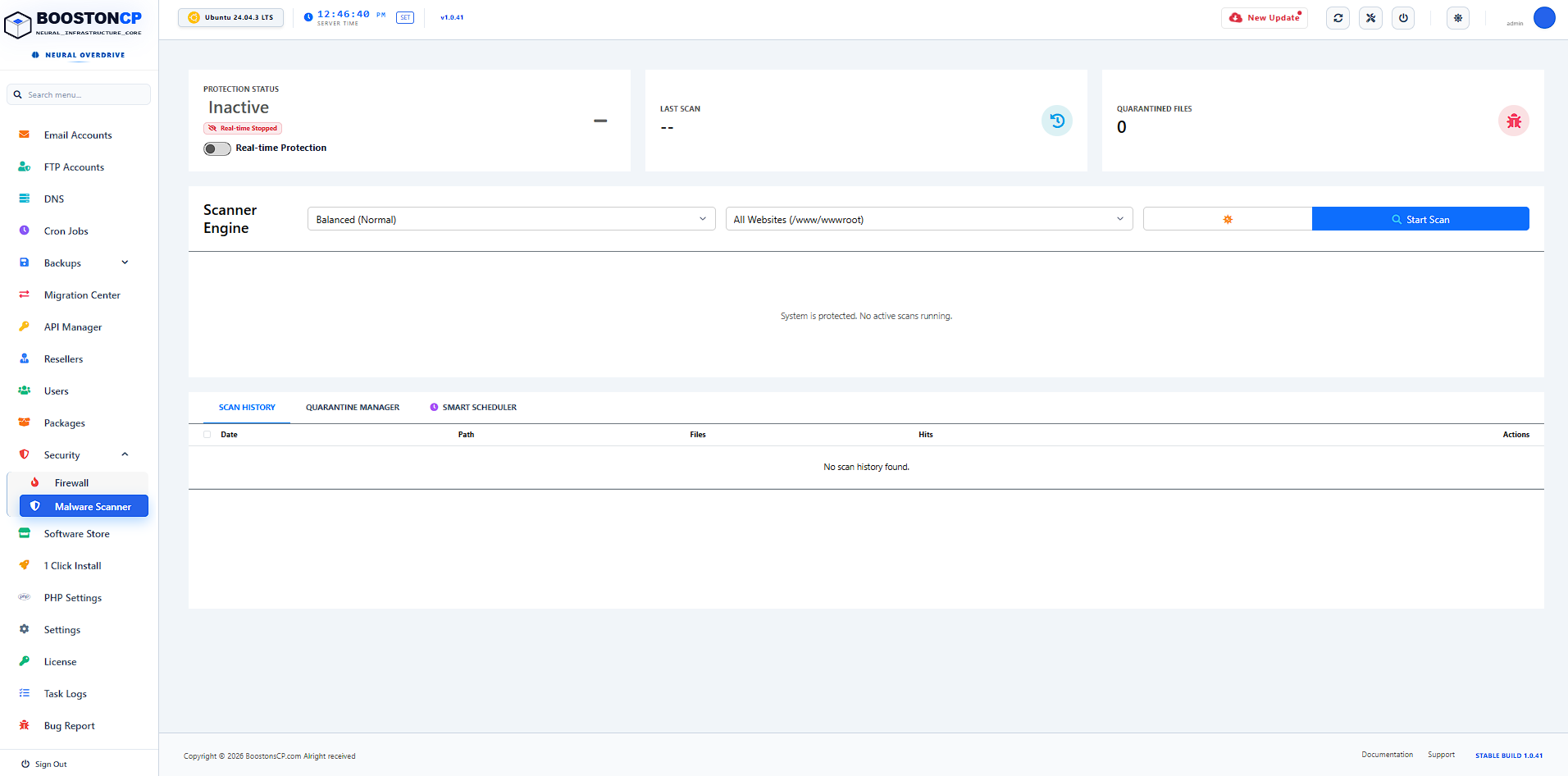
- Secure Jailshell (The CageFS Killer): BoostonCP utilizes strict
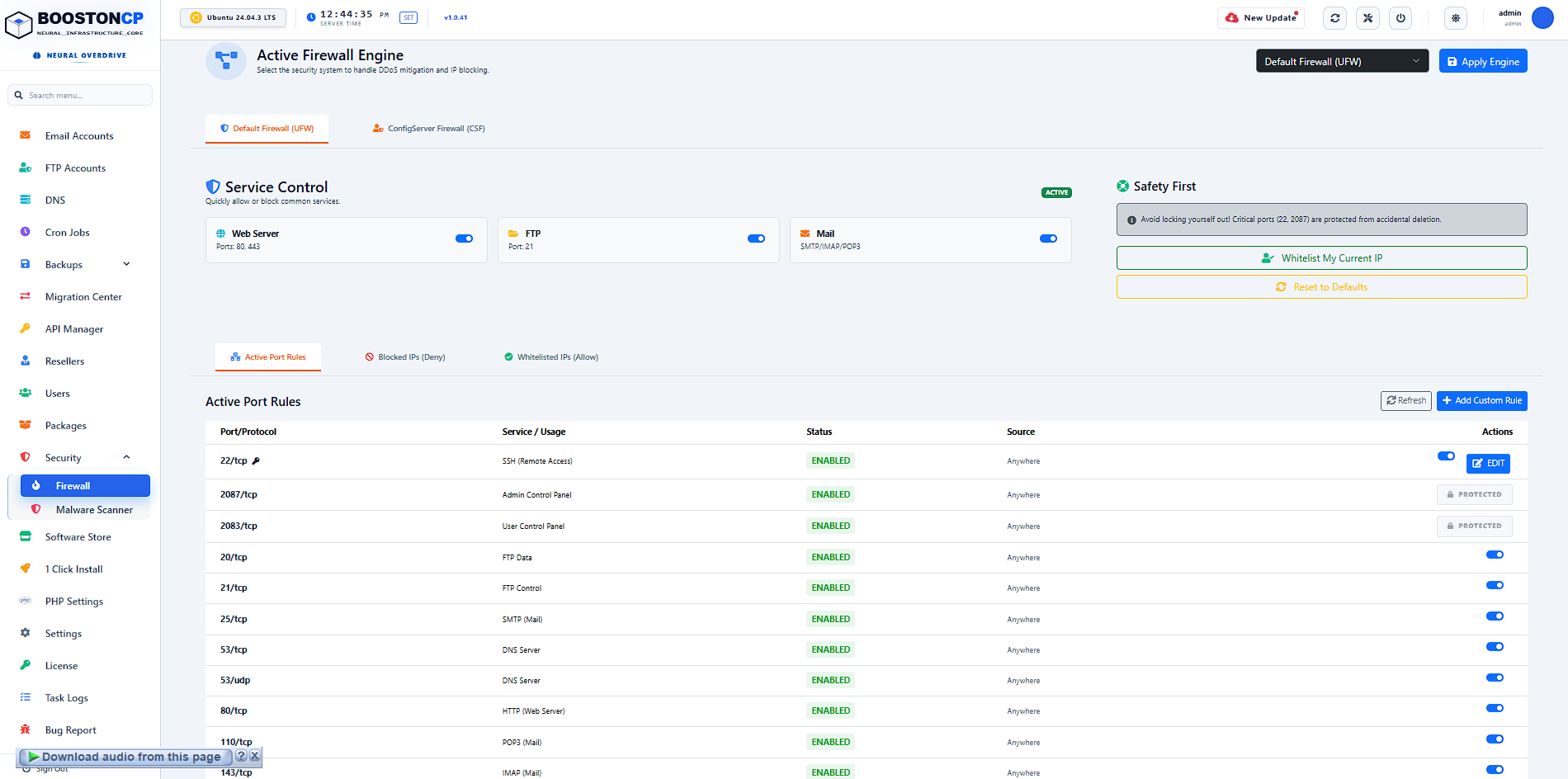
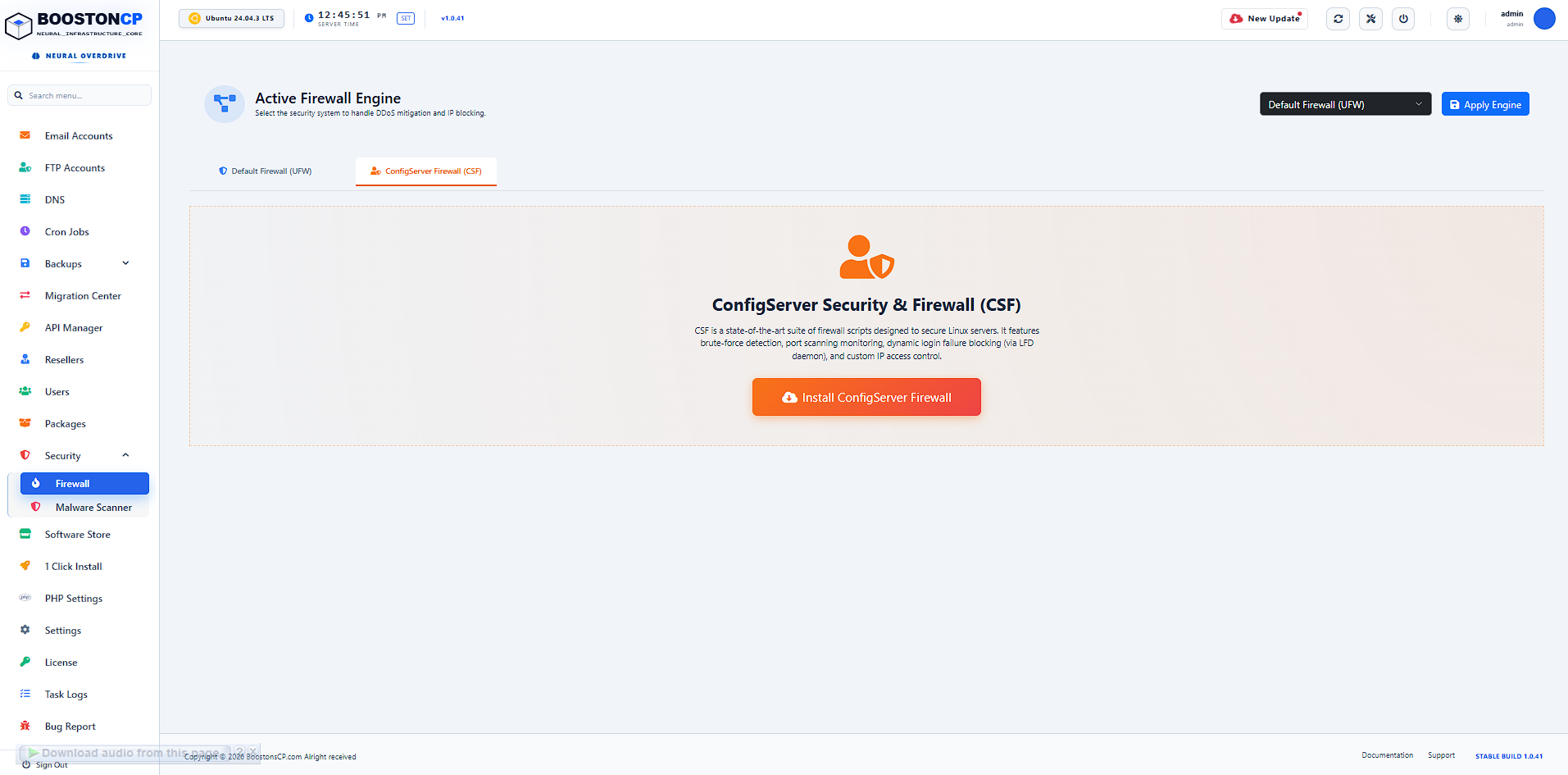
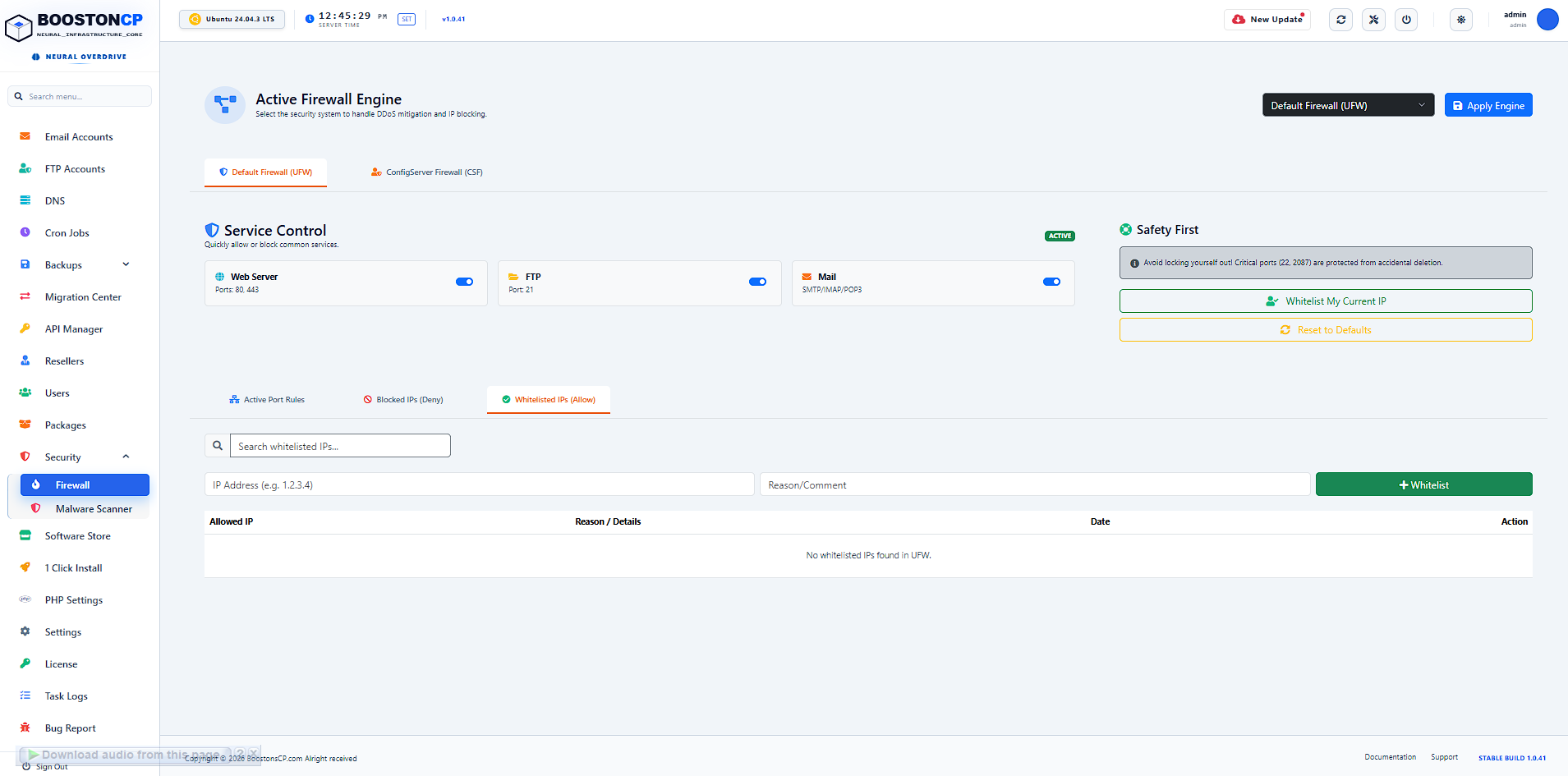
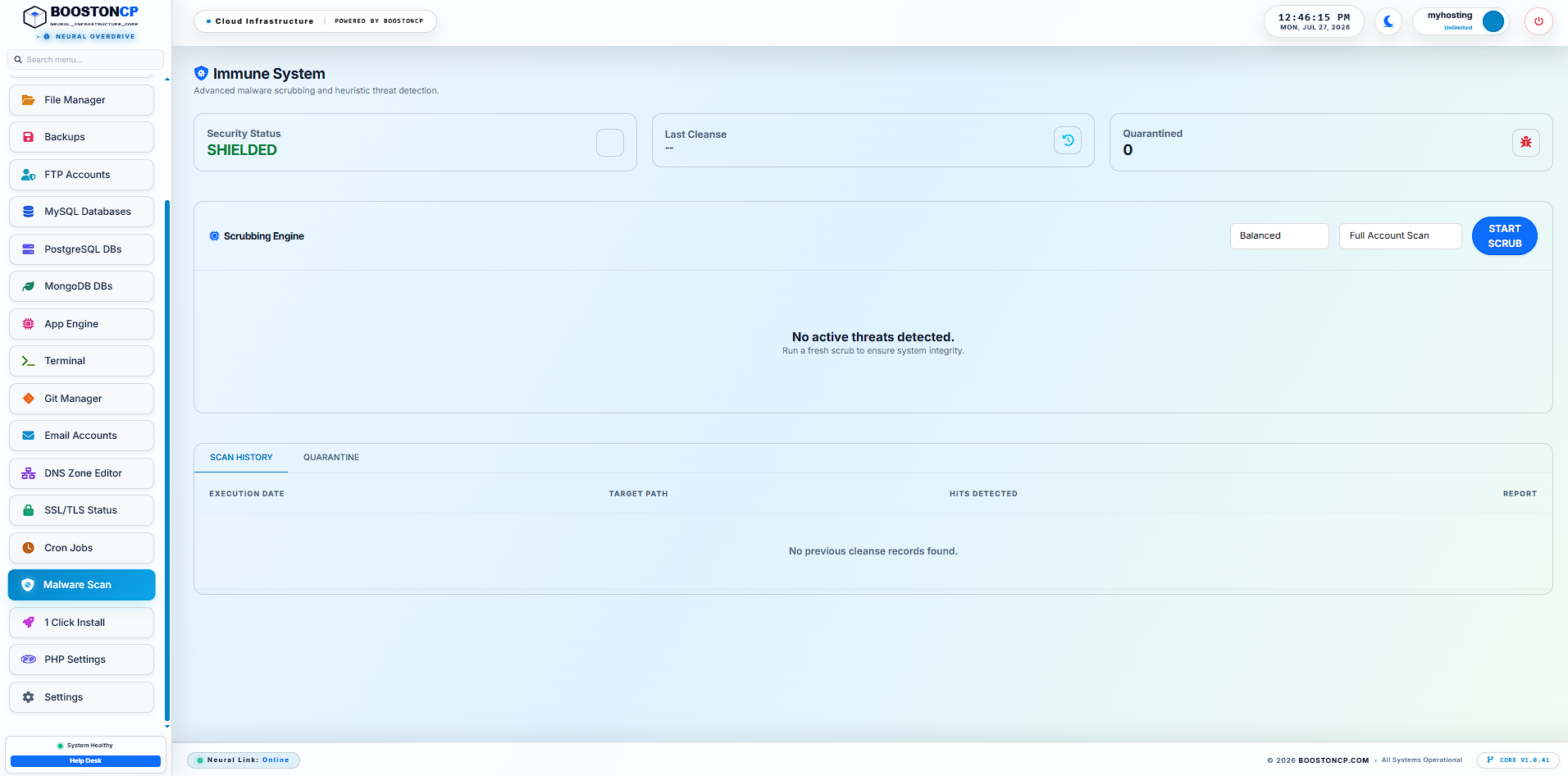
bubblewrapsandboxing to deploy a "Secure Jailshell." Even if a user accesses the terminal via SSH, their entire world is locked to their specific/www/wwwroot/domaindirectory. They cannot see other users, system binaries, or root files. - Active Firewall Engine & Malware Scanner (The Imunify360 Killer): BoostonCP ships with a deeply integrated Active Firewall Engine capable of instantly toggling between standard UFW and industry-standard ConfigServer Security & Firewall (CSF) with a single click. Furthermore, BoostonCP includes an advanced Immune System (Malware Scanner). Not only can admins run server-wide scans, but end-users have the absolute freedom to run on-demand "Scrubbing Engine" malware scans on their own accounts directly from their dashboard.
The Data Comparison: Legacy LVE vs BoostonCP Native Cgroups
When evaluating a CloudLinux alternative, raw data speaks louder than marketing. Let's compare the traditional LVE approach against BoostonCP's native OS integration.
| Feature Element | Legacy Panels + CloudLinux | BoostonCP (Native OS) | | :--- | :--- | :--- | | **Underlying Technology** | Proprietary LVE Kernel Patch | Native Linux `cgroups v2` & `systemd` | | **Licensing Cost** | $14 to $20+ per server / month | **$0 (100% Free forever)** | | **Performance Overhead** | Moderate (Extra software layer) | Near-Zero (Direct kernel hardware scheduler) | | **Process Tracking** | Polling via LVE daemons | Real-time via `cpu.stat` and `memory.current` | | **Node.js/Python Sandboxing**| Requires complex Passenger setups | Native PM2/venv bounded to user slice | | **Deployment Speed** | Reboot often required for patches | Instantaneous real-time limit application |As the table demonstrates, migrating from cPanel or CyberPanel to BoostonCP not only fixes high CPU usage anomalies but completely transforms your profit margins by removing recurring licensing overhead.
Mandatory USPs: Why BoostonCP is the Ultimate Control Panel
Resource isolation is just one pillar of BoostonCP's engineering marvel. While other panels nickel-and-dime you for features, BoostonCP delivers unparalleled value and flexibility that legacy competitors simply cannot match.
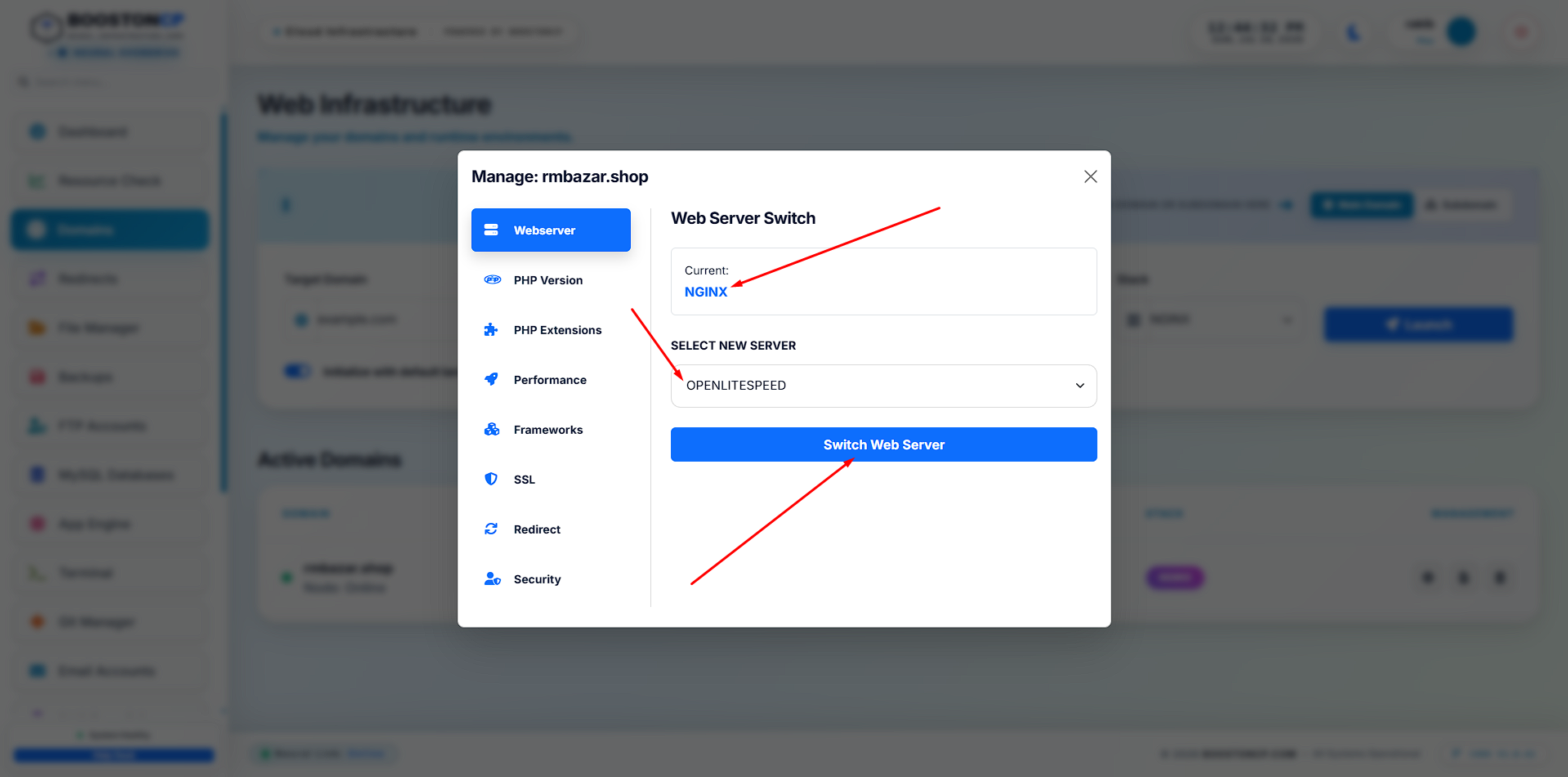
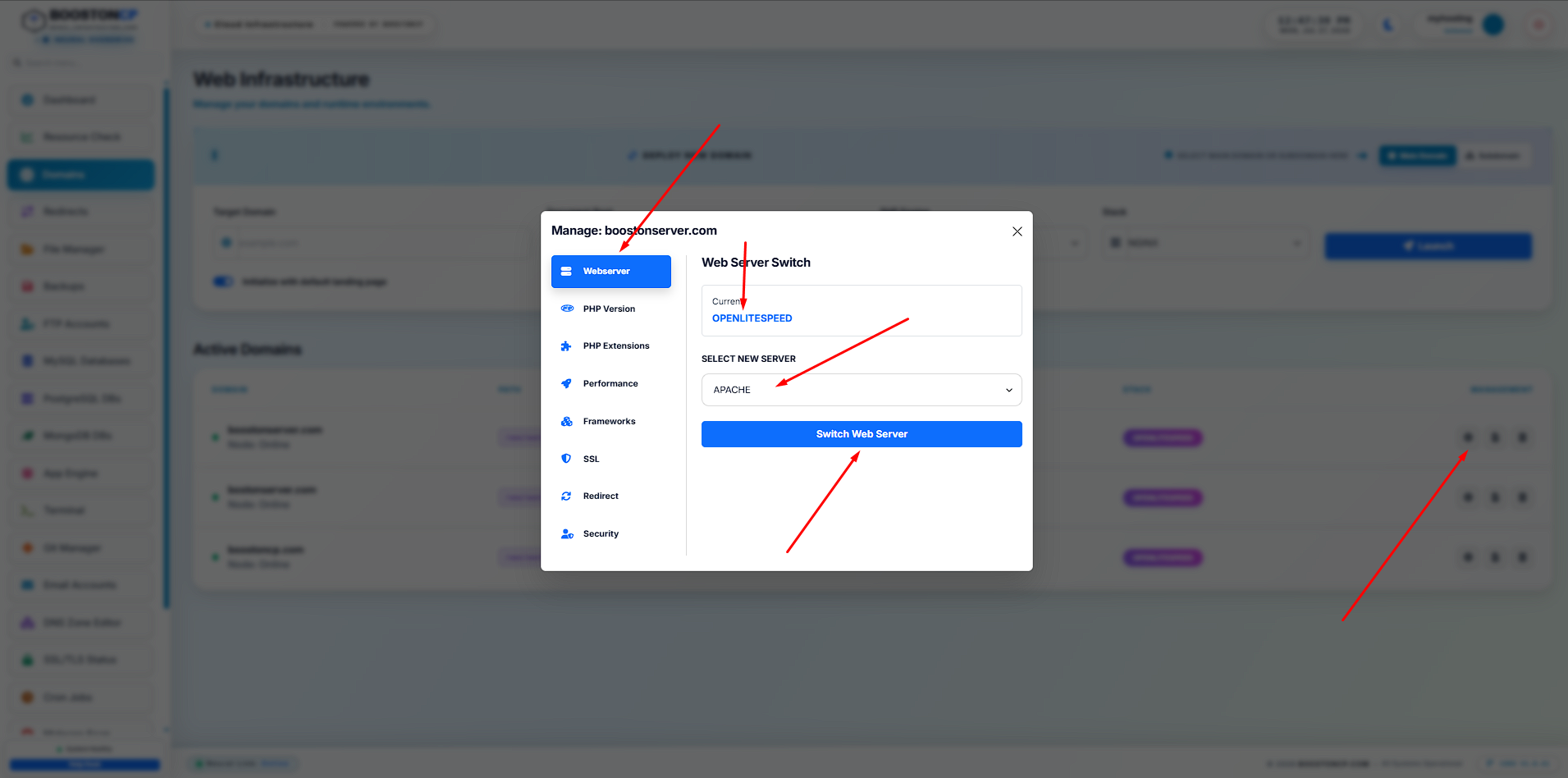
World's Only Domain-Level Webserver Switch
In traditional control panels, the entire server is married to one webserver ecosystem. If you run Apache, all your clients run Apache. If you want to use OpenLiteSpeed, you must globally recompile or restart the webserver, disrupting every single domain on the machine. This is a monolithic, fragile design.
BoostonCP is the ONLY control panel in the world capable of switching webservers on a strict per-domain basis. Utilizing a highly advanced Dynamic Edge Routing architecture, you can have Domain A running on raw Nginx, Domain B on robust Apache, and Domain C on high-speed OpenLiteSpeed—all simultaneously on the exact same server. If you want a deep dive on these engines, read our complete guide on Nginx vs OpenLiteSpeed vs Apache in 2026. Switching a domain's web engine takes less than 1 second and causes zero downtime for the rest of the system. This level of granular control is unprecedented in the hosting industry.
Lifetime Free License with Unlimited Websites
Tired of paying for "Account Limits"? Competitors offer free versions that artificially restrict you to 5 or 10 websites, forcing you to upgrade to exorbitant premium tiers just to add more domains.
BoostonCP offers a genuine Lifetime Free License that allows you to host UNLIMITED websites. There are zero domain caps. The only restriction on the free tier is structural for business reselling: it allows the creation of 1 Reseller and 1 Standard User account. However, because the BoostonCP Admin acts as both the Root and a User simultaneously, you don't even need to create separate user accounts to host your own infinite portfolio of domains. Enjoy Enterprise-grade features without the enterprise price tag.
Step-by-Step: Verifying Native Isolation Limits
Do you want to see the power of cgroups v2 in action on your server? Once you migrate to BoostonCP, you can empirically verify that your users are safely sandboxed without CloudLinux.
- Assign Limits: In the BoostonCP Admin dashboard, navigate to Packages and set a package to 1 CPU Core and 512MB RAM. Assign this package to a user.
- Access the Terminal: SSH into your server as root.
- Identify the User UID: Run
id -u usernameto find the user's system ID (e.g., 1005). - Check the Kernel Slice: Navigate to the systemd cgroup path:
cd /sys/fs/cgroup/user.slice/user-1005.slice - Verify RAM Hard-Cap: Run
cat memory.max. You will see536870912(which is exactly 512MB in bytes). The Linux hardware scheduler is now mathematically enforcing your limit. No LVE license required!
Conclusion: The End of the CloudLinux Tax
The web hosting industry has evolved. For years, we accepted the high cost of third-party OS patches because we had no other choice. Today, the choice is clear. By leveraging the raw power of the modern Linux kernel, `cgroups v2`, and systemd, BoostonCP delivers flawless, hardware-level noisy neighbor protection straight out of the box.
Stop paying the CloudLinux tax. Stop battling 502 Bad Gateway errors caused by archaic resource bottlenecks. Upgrade your infrastructure to an architecture designed for the future.
Frequently Asked Questions (FAQ)
What is the best CloudLinux alternative in 2026?
The best CloudLinux alternative is utilizing native Linux kernel cgroups v2 and systemd slices. Control panels like BoostonCP integrate directly with the OS to provide enterprise-grade resource isolation (CPU, RAM, IO limits) for free, eliminating the need for paid LVE licenses.
How does cgroups v2 fix high CPU usage in shared hosting?
cgroups v2 allows the operating system to create a strict sandbox around a user's processes. If a website experiences high CPU usage due to a bad script or attack, the kernel physically throttles that specific user, ensuring the rest of the server remains unaffected.
Do I need CloudLinux to stop the Noisy Neighbor effect?
No. While CloudLinux was necessary on older operating systems like CentOS 6/7, modern Linux distributions (Ubuntu 22.04+, Debian 12) have built-in resource control via cgroups v2. Using an advanced control panel like BoostonCP unlocks this native feature automatically.
Can I migrate from cPanel to fix CPU usage limits without losing data?
Yes. BoostonCP provides 1-click migration tools that seamlessly transfer your accounts, databases, and files from cPanel. Once migrated, BoostonCP automatically applies hardware-level CPU and RAM caps to all accounts, instantly fixing runaway resource issues.
Does cgroups v2 restrict MySQL databases like CloudLinux MySQL Governor?
Yes, but natively. BoostonCP features a built-in MySQL Governor engine that tracks live SQL connection spikes and allows for instant throttling, protecting the database layer from abusive queries without requiring an LVE license.
Can end-users manage their own PHP extensions with BoostonCP?
Absolutely. Unlike traditional setups that restrict PHP configurations globally, BoostonCP empowers users to toggle specific PHP kernel extensions (like imagick or redis) and change memory limits on a per-domain basis directly from their user panel.
Ready to Eliminate Your Software Taxes?
Experience native Linux resource isolation and the world's only per-domain webserver switch. Deploy BoostonCP today and take back control of your profit margins.