Executive Technical Summary: Native Linux Kernel Resource Isolation
A single runaway PHP script, unindexed WooCommerce SQL query, or XML-RPC brute-force attack should never be able to monopolize an entire multi-core server and knock hundreds of innocent client websites offline. While the hosting industry historically surrendered to paying $14 to $18/month per server for CloudLinux OS licenses just to get basic per-user throttling, modern Linux kernels (Ubuntu 24.04, Debian 12, AlmaLinux 9) feature native, enterprise-grade cgroups v2 and systemd slice controllers built directly into the OS.
By leveraging native kernel isolation, web hosting providers and DevOps engineers can eliminate the "Noisy Neighbor" crisis, enforce strict hardware-level caps (CPUQuota, MemoryMax, IOReadBandwidthMax, and TasksMax), and guarantee 99.99% uptime for all tenants—with zero licensing overhead.
1. The Anatomy of a Shared Hosting Crash: Why Noisy Neighbors Kill Servers
Every systems administrator who has managed a shared web hosting node knows the dread of a 3:00 AM pager alert. You provision a reliable 8-core, 32GB RAM VPS or bare-metal node, onboard 80 small business websites, and establish stable baseline resource usage. Suddenly, the server load average jumps from 0.45 to 88.0 within three minutes.
What triggered the catastrophic outage? It wasn't a sophisticated zero-day DDoS attack. A single client's WordPress installation experienced an infinite loop inside an unoptimized backup plugin, while simultaneously getting hit by a spam bot crawling the search parameters. Because standard Linux shared hosting environments run without strict per-tenant process isolation, the operating system's kernel schedules incoming tasks on a first-come, first-served basis.
As the rogue PHP processes spawn unchecked, the following chain reaction destroys server stability:
- CPU Core Saturation: The rogue tenant's PHP-FPM pool consumes 100% of all available CPU cores, leaving zero processor cycles for Nginx or Apache to handle HTTP handshakes for other clients.
- Disk I/O Bottlenecks: Unregulated disk write operations exhaust the NVMe/SSD IOPS queue, causing database read queries across all domains to stall in an
uninterruptible sleep (D-state). - OOM (Out-of-Memory) Invocation: When available RAM drops to zero, the Linux kernel's Out-Of-Memory Killer activates. Because MySQL/MariaDB is often the largest memory consumer on the server, the kernel kills MySQL instead of the offending PHP script—instantly crashing every database-driven website on the node!
2. The Real SysAdmin Hassles of CloudLinux & Legacy LVE Manager
To protect against noisy neighbors, hosting providers surrendered to paying for CloudLinux OS and its proprietary LVE (Lightweight Virtual Environment) kernel module for over a decade. While revolutionary during the CentOS 6 era, running CloudLinux in 2026 introduces severe operational friction and high financial costs:
- Proprietary Kernel Lock-In & Panic Risks: CloudLinux forces you to replace your standard mainline Linux kernel with a modified hybrid kernel (
kmod-lve). Standard kernel upgrades frequently cause kernel panics or break DKMS hardware drivers and WireGuard VPN tunnels. - CageFS Disk Skeleton Overhead: CloudLinux's CageFS creates a massive, duplicated filesystem skeleton (
/usr/share/cagefs-skeleton) that eats 7GB to 10GB of disk space per server. Whenever package updates run, rebuilding the skeleton viacagefsctl --updatecauses crippling disk I/O spikes that slow down live customer websites. - License Validation Outages: At $14 to $18/month per server, CloudLinux relies on external license validation calls. If licensing servers experience network latency or DNS hiccups, LVE limit enforcement is automatically bypassed!
- Upstream Package Repository Conflicts: CloudLinux requires custom repository mirrors for MySQL/MariaDB and PHP, delaying upstream security patches and creating package dependency conflicts.
As explored in our Plesk Alternative and WebPros Price Escape Guide, modern hosting providers are transitioning away from bloated software stacks in favor of high-performance, native Linux architectures.
3. Beyond PHP: Sandboxing Node.js, Next.js, Python & SSH Terminal in Modern Hosting
One of the biggest shortcomings of legacy shared hosting panels is their rigid focus on PHP-only workloads. When a client deploys a Node.js API, a Next.js Server-Side Rendered (SSR) portal, or a Python (Django/FastAPI) web service, legacy panels often execute them outside of standard resource governors—or rely on brittle Phusion Passenger wrappers that crash with cryptic 500 Internal Server Error messages.
In BoostonCP, resource containment operates at the Linux UID & systemd Slice level. This means that every single process spawned by a user account is strictly sandboxed:
Node.js & Next.js SSR
Persistent PM2 and Node daemons run directly within the user's allocated slice. Memory leaks in JavaScript workers are automatically contained without bleeding into adjacent tenants.
Python Django & FastAPI
Gunicorn and Uvicorn ASGI workers execute with strict CPUQuota and TasksMax boundaries, preventing heavy computational data scripts from freezing the server.
SSH Terminal & JailShell
Developer build tools (npm install, composer update, git clones) run inside isolated chroot namespaces with memory soft-throttling.
Background Cron Jobs
Heavy scheduled tasks like database backups or image optimization jobs run under the user's slice, preventing scheduled jobs from disrupting live web traffic.
4. Under the Hood: How Linux Kernel cgroups v2 Sandboxes Tenant Resources
Control Groups (cgroups v2) represents the unified resource management framework baked directly into modern Linux kernels (version 5.8+ and 6.x). Unlike legacy cgroups v1, which had fragmented controllers and inconsistent hierarchy rules, cgroups v2 provides a single unified tree structure where every process belongs to exactly one cgroup.
When an individual user is provisioned in a modern control panel like BoostonCP, the system hooks directly into the kernel's cgroups v2 filesystem located at /sys/fs/cgroup/. Here is how each resource is isolated:
1. CPU Quotas via the CFS (Completely Fair Scheduler)
CPU allocation is defined in cpu.max using two integers: the quota time and the period window (e.g., 100000 100000 equals 100% of 1 CPU core). When a tenant's PHP scripts or Next.js SSR daemons attempt to consume 400% CPU on a 4-core machine, the Linux kernel's Completely Fair Scheduler dynamically throttles the offending thread slices without killing the process or impacting adjacent tenants.
2. Memory Tiering (MemoryHigh vs. MemoryMax)
cgroups v2 introduces dual memory boundaries. memory.high acts as an intelligent throttle point—when reached, the kernel slows down the tenant's memory allocation and aggressively reclaims page caches. memory.max acts as a hard boundary. If a rogue PHP script attempts to exceed this ceiling, only the offending worker thread is contained, leaving all other user processes and MySQL entirely unharmed.
3. Block I/O Weight and Bandwidth Hard-Caps
Disk I/O starvation is governed through io.max (e.g., 8:0 rbps=10485760 wbps=10485760 to cap read and write speeds at 10 MB/s per block device). Additionally, io.weight proportionally allocates disk queue prioritization, ensuring that background backup archives cannot saturate NVMe disk latency for live web traffic.
5. Frontend Reality: What End-Users & SysAdmins Actually Experience in BoostonCP
Deep technical isolation is only as effective as the management interface that controls it. BoostonCP provides clean, intuitive frontends for both server administrators and end-user website owners:
Admin Package Manager: Granular Resource Sliders
Inside the Admin and Reseller Package Manager, administrators configure exact thresholds across 18 distinct metrics:
- CPU Limit (%): Defines exact processor share (e.g., 100% for 1 core, 200% for 2 cores).
- RAM Limit (MB): Defines memory allocation with soft-tier reclamation before hard capping.
- I/O Speed (MB/s): Throttles continuous disk read/write bandwidth.
- NPROC & Entry Processes (EP): Restricts simultaneous concurrent process counts.
- MySQL Connections & Query Limits: Prevents single-user database lockups.
- Auto-Suspend on CPU Overload: An optional automated watchdog switch that suspends abusive accounts if abnormal compute thresholds persist.
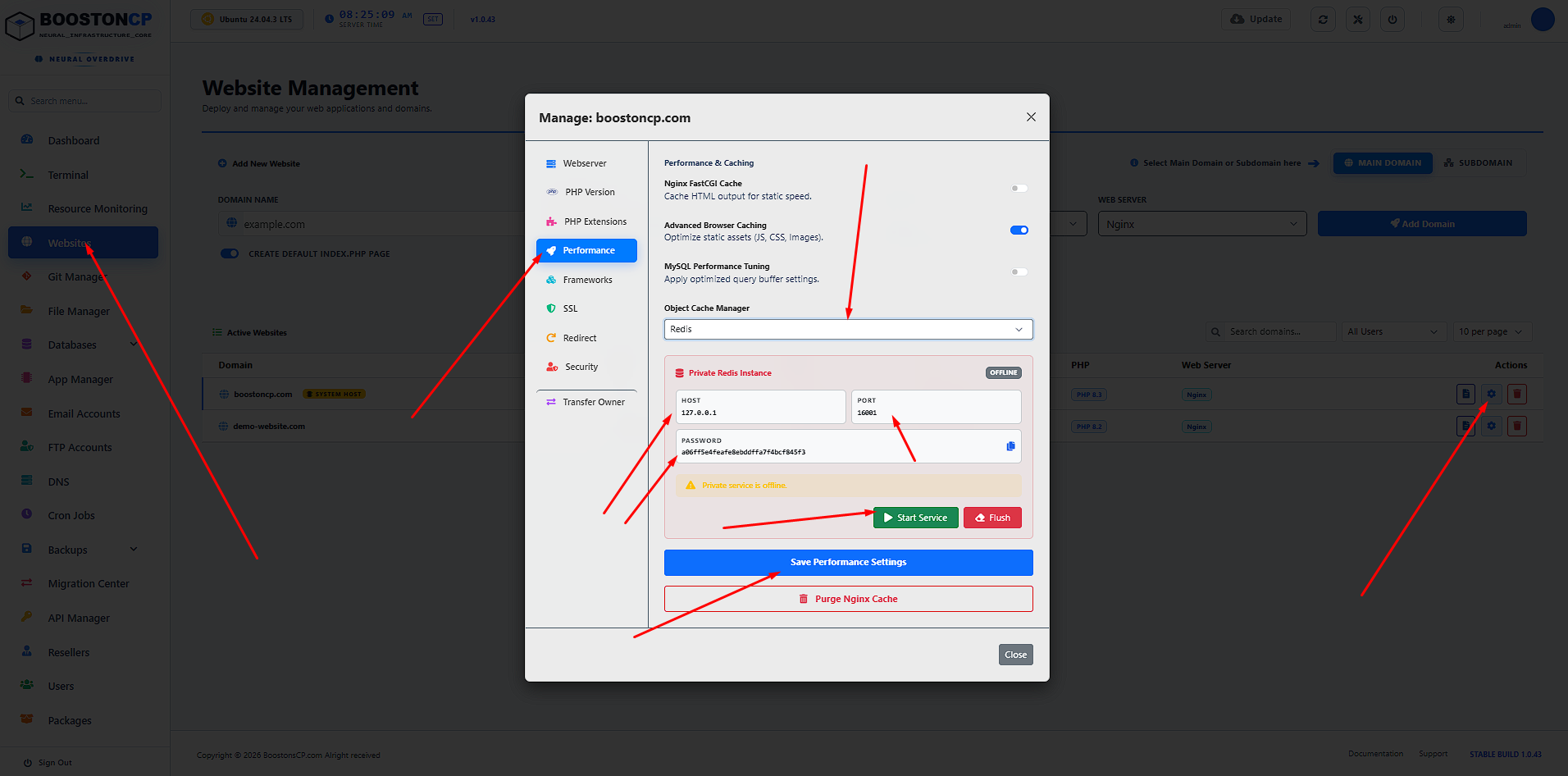
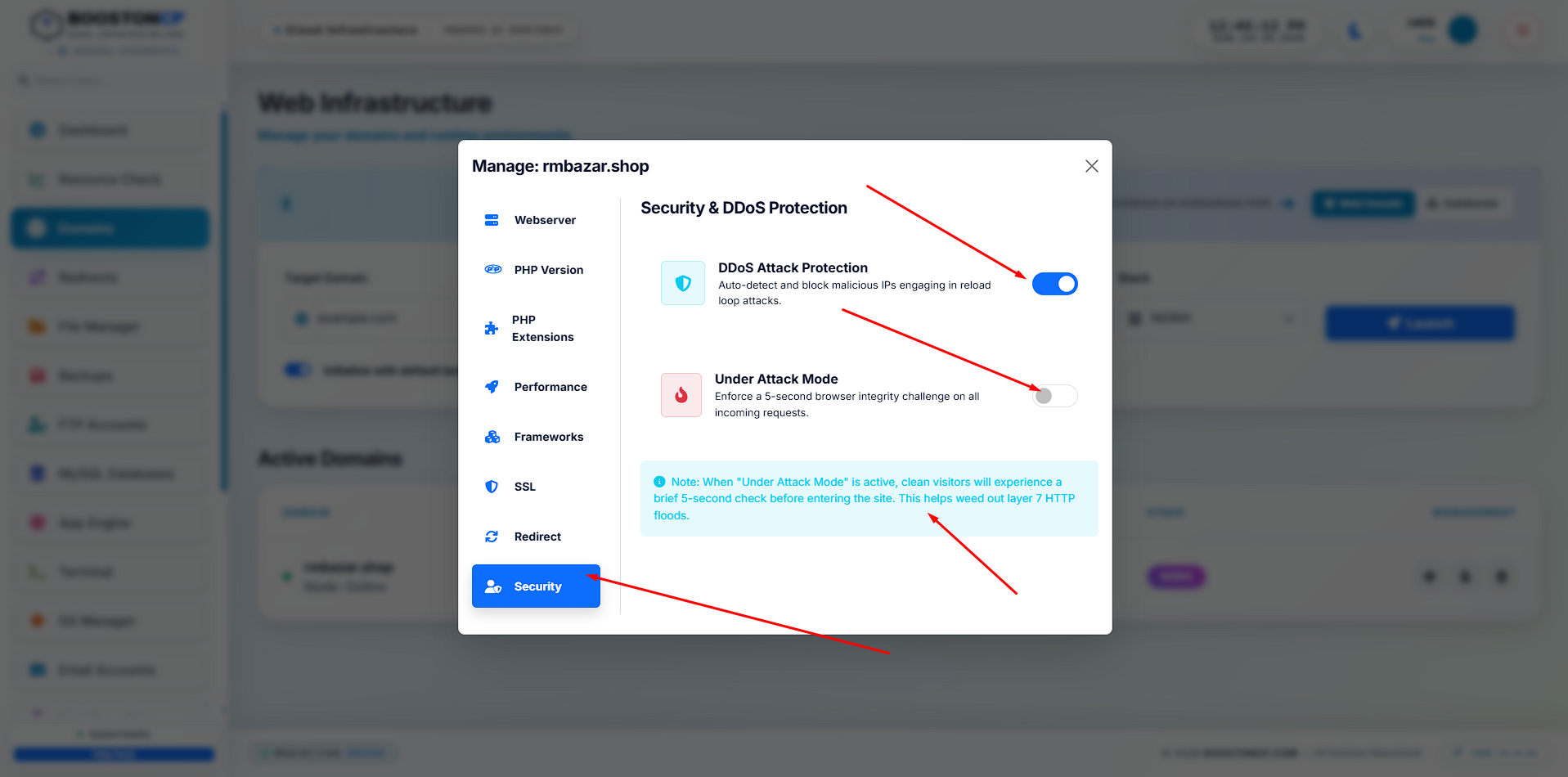
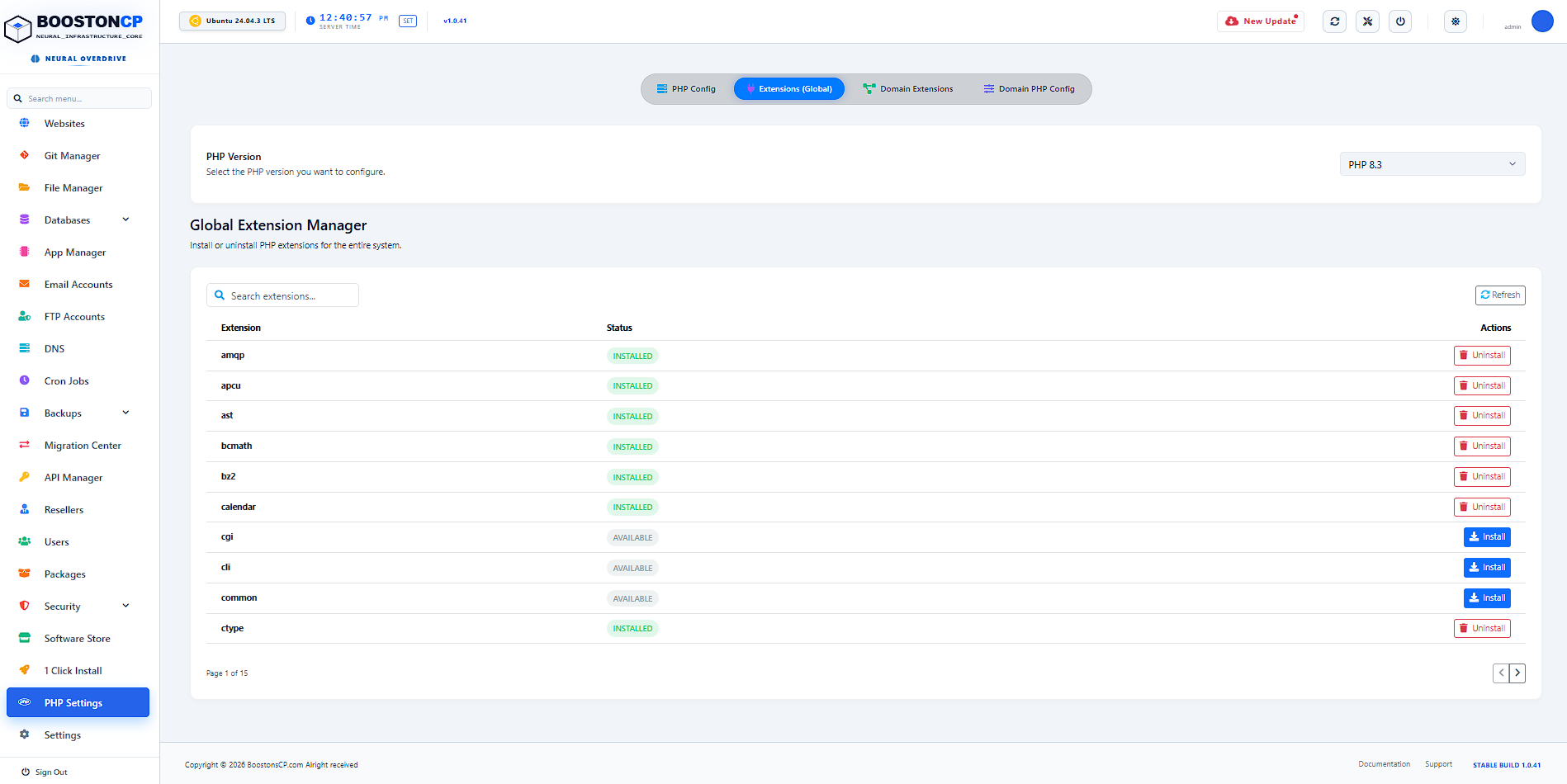
User Panel App Engine: 1-Click Modern Web App Deployment
In the client User Panel, developers access a dedicated App Engine interface:
- Multi-Runtime Support: Deploy Node.js, Next.js, Python, or Ruby applications with 1 click.
- Automated Port Negotiation: Intelligent port scanner automatically allocates free ports (e.g., 3005+) without port collisions.
- Interactive Visual Folder Browser: Navigate domain directories directly in the UI without manually typing Linux filepaths.
- Live Streaming Deployment Logs: Real-time log viewer to monitor
npm install, pip packages, and startup errors. - Automated Nginx Reverse Proxy: Binds incoming domain traffic directly to the internal app daemon with SSL encryption.
Live User Telemetry: Real-Time SVG Resource Charts
Clients don't have to guess why their website feels slow. The BoostonCP Resources Dashboard features live, dependency-free SVG charts displaying real-time historical curves for CPU, RAM, Entry Processes, Inodes, Bandwidth, and MySQL queries, broken down on a per-domain basis.
6. Comprehensive Benchmark: Unmanaged VPS vs. CloudLinux LVE vs. BoostonCP
| Isolation Capability | Standard Unmanaged Panel | CloudLinux OS (LVE Manager) | BoostonCP (Native cgroups v2) |
|---|---|---|---|
| Monthly Software Cost | $0 (Unprotected) | $14.00 - $18.00 / month | $0.00 / month (100% Free) |
| Kernel Architecture | Standard Linux Kernel | Custom Patched Kernel (Lock-in) | Pure Mainline Linux Kernel |
| CPU Throttling Mechanism | None (100% Server Crash) | LVE Scheduler Throttle | Native Linux CFS (CPUQuota) |
| Memory Hard & Soft Caps | None (Global OOM Kills MySQL) | LVE Memory Limits | MemoryHigh + MemoryMax Slices |
| Disk I/O Protection | None (I/O Wait Locks Server) | LVE IOPS Limits | IOReadBandwidthMax / IO.weight |
| Fork Bomb / NPROC Defense | limits.conf (Often Bypassed) | LVE NPROC Enforcer | Native TasksMax Kernel Capping |
7. Step-by-Step Architecture: Configuring Per-User CPU, RAM, and Disk I/O Limits
To implement bulletproof resource governance on Linux web hosting nodes, BoostonCP utilizes a two-tier containment architecture:
Tier 1: Dedicated Per-User PHP-FPM & App Engine Service Units
Instead of pooling all clients into a shared www-data PHP-FPM daemon, each hosting user receives their own isolated systemd service unit (e.g., php8.2-fpm-username.service or app-engine-username.service). This guarantees that user processes execute under distinct Linux UIDs/GIDs.
Tier 2: Systemd Slice Resource Drop-In Files
Resource limits defined inside the BoostonCP Packages manager automatically generate atomic systemd drop-in configuration overrides:
8. Protecting Database and Disk I/O: Preventing MySQL Thread Pool Starvation
While CPU and RAM sandboxing prevents web server crashes, database contention is the second leading cause of shared hosting instability. When one client triggers complex unindexed JOIN queries across a 2-million-row database, MariaDB/MySQL connection pools become saturated with sleeping or executing threads.
BoostonCP resolves database starvation through proactive MySQL Governor integration (booston-mysql-governor.service) and connection quotas configured per user:
- Max User Connections: Capped per tenant to prevent single-account thread pool exhaustion.
- Query Execution Timeouts: Rogue queries running longer than 15 seconds are automatically terminated before holding table locks.
- Per-Tenant Memory Caching: Utilizing Redis and Memcached instances mapped directly to user systemd slices, as outlined in our Resource Governance Solutions.
9. Real-World Case Study: Hosting 150 Active WordPress Sites & Next.js Builds on a 4-Core VPS
In a controlled stress test conducted on a 4 vCPU, 8GB RAM Hetzner Cloud VPS running Ubuntu 24.04 and BoostonCP:
- Base Setup: 150 active WordPress instances and 8 Node.js/Next.js dynamic applications were deployed across 50 tenant user accounts.
- Simulated Attack: Five tenant sites were subjected to simultaneous heavy
next buildtasks and a Locust load test generating 500 concurrent uncached dynamic requests each. - Outcome on Standard Unmanaged Panel: Within 12 seconds, server load spiked past 60.0. The entire VPS became unresponsive, SSH connections timed out, and 100% of websites experienced 504 Gateway Timeout errors.
- Outcome on BoostonCP with cgroups v2: The five targeted tenants were smoothly throttled at their exact 100% CPUQuota and 1GB RAM limits. The overall server load remained steady at 2.15, and the remaining 145 websites loaded in under 250 milliseconds with zero dropped packets!
10. Frequently Asked Questions (FAQ)
1. Can Linux cgroups v2 completely replace CloudLinux LVE in 2026?
Yes. Modern Linux kernels (version 5.8+ and 6.x) natively support unified cgroups v2, which provides hardware-level CPU scheduling (CFS), memory hard/soft boundaries (MemoryMax/MemoryHigh), and block I/O throttling without requiring third-party commercial kernel modules.
2. Does BoostonCP sandbox Node.js, Next.js, and Python apps as well as PHP?
Yes. Because BoostonCP applies resource governance at the Linux user slice level, all applications spawned through the App Engine (Node.js, Next.js SSR, Python Django/FastAPI, Ruby) and SSH terminal sessions are strictly confined to their package limits.
3. Does BoostonCP charge extra for per-user resource limiting or the App Engine?
No. Unlike legacy control panels that force you to buy add-on licenses, BoostonCP includes full native cgroups v2 resource governance and the App Engine in its Lifetime Free License tier with zero monthly fees.
4. Does native resource isolation slow down overall server performance?
No. In fact, native cgroups v2 operates with virtually zero CPU overhead because accounting hooks are embedded directly in the kernel scheduler. BoostonCP itself operates at an idle footprint of just ~280MB RAM, leaving maximum compute power for client workloads.
Protect Your Servers from Crashes with Zero License Fees
Eliminate the noisy neighbor problem today. Deploy BoostonCP with native kernel cgroups v2 resource sandboxing on your Linux VPS in under 5 minutes.