Executive Summary
For years, the web hosting industry has relied on paid third-party OS patches like CloudLinux simply to obtain the PHP Selector feature. Legacy control panels force a single global php.ini configuration across all users, causing massive security vulnerabilities and RAM bloat. BoostonCP revolutionizes this architecture by utilizing native PHP-FPM pools. Without any third-party licenses, BoostonCP allows administrators and end-users to dynamically toggle PHP extensions (like redis, imagick) and enforce strict memory limits on a strict per-domain basis. This exhaustive guide explores how native socket-level configuration makes CloudLinux's PHP Selector technically obsolete.
If you manage a web hosting node or operate a digital agency, you understand the delicate balancing act of PHP configuration in a shared environment. In traditional setups running legacy control panels, every single website on the server is tethered to a monolithic, global php.ini file. This creates an immediate architectural paradox: you must balance the complex needs of modern frameworks against the strict security requirements of hundreds of diverse clients.
Imagine a scenario where Client A runs a highly customized Laravel application that strictly requires the redis and imagick PHP extensions. Meanwhile, Client B runs a simple, static HTML site, and Client C runs an outdated, highly vulnerable WordPress blog.
In a legacy environment, to satisfy Client A, the System Administrator must globally install and enable imagick for the entire server. Suddenly, every single PHP process spawned by Client B and Client C is also loading the imagick module into memory. This causes massive, unnecessary RAM consumption across the node. Worse, if a zero-day vulnerability is discovered in that specific extension, every single website on the server is instantly compromised. This lack of granular control is the primary reason the industry became dependent on CloudLinux.
The Expensive Band-Aid: CloudLinux PHP Selector
To combat this global configuration nightmare, hosting providers surrendered to CloudLinux and its flagship feature: the PHP Selector. CloudLinux engineered a custom patch wrapped inside their LVE (Lightweight Virtual Environment) and CageFS ecosystems, allowing end-users to select their PHP version and individually check boxes to enable specific extensions just for their account.
While this solved the immediate problem, it introduced a new, systemic issue: the Software Tax. In 2026, paying a recurring monthly licensing fee per server just to dictate which PHP modules load for which user is an archaic concept. The underlying Linux operating system, specifically via the PHP FastCGI Process Manager (PHP-FPM), has evolved to support this natively. Yet, because legacy panels (like cPanel, Plesk, and DirectAdmin) are trapped in decades-old monolithic architectures, they refuse to modernize their core engines, forcing you to continuously pay the CloudLinux tax.
The Native Revolution: Understanding PHP-FPM Pools
When searching for a true CloudLinux PHP selector alternative, we must look to the core architecture of PHP itself. Modern high-performance web stacks utilize PHP-FPM (FastCGI Process Manager). Unlike the older mod_php (which ran inside the Apache worker), PHP-FPM spawns independent, daemonized processes that communicate with the web server (Nginx or OpenLiteSpeed) via Unix sockets or TCP ports.
The true power of PHP-FPM lies in its "Pool" architecture. A server can have dozens of different PHP-FPM pools running simultaneously, each with its own unique configuration, user permissions, and environment variables. This is the exact technology that BoostonCP harnesses to deliver absolute, hardware-level PHP isolation without requiring any proprietary licenses.
root@server:~# cat /www/server/php/81/etc/pool.d/client-domain.com.conf
[client-domain.com]
listen = /tmp/php-cgi-81-client.sock
listen.owner = client1005
listen.group = client1005
user = client1005
group = client1005
; The Magic: Injecting Native Extension Overrides at the Socket Level
php_admin_value[memory_limit] = 512M
php_admin_value[extension] = redis.so
php_admin_value[extension] = imagick.so
php_admin_flag[display_errors] = off
As you can see from the raw configuration dump above, BoostonCP completely bypasses the global php.ini. Instead, the backend engine dynamically injects php_admin_value directives directly into the specific domain's FPM pool. This means that redis.so and imagick.so are loaded exclusively for this single domain. The rest of the server remains untouched, incredibly lean, and vastly more secure. This is native per-domain php isolation executed perfectly.
How BoostonCP Engineers Ultimate PHP Freedom
BoostonCP was built from the ground up to empower both the Root Administrator and the End-User. By shifting the paradigm away from global configurations and toward granular, domain-level architecture, BoostonCP eliminates the need for expensive third-party wrappers like CloudLinux.
1. True Per-Domain Extension Toggling
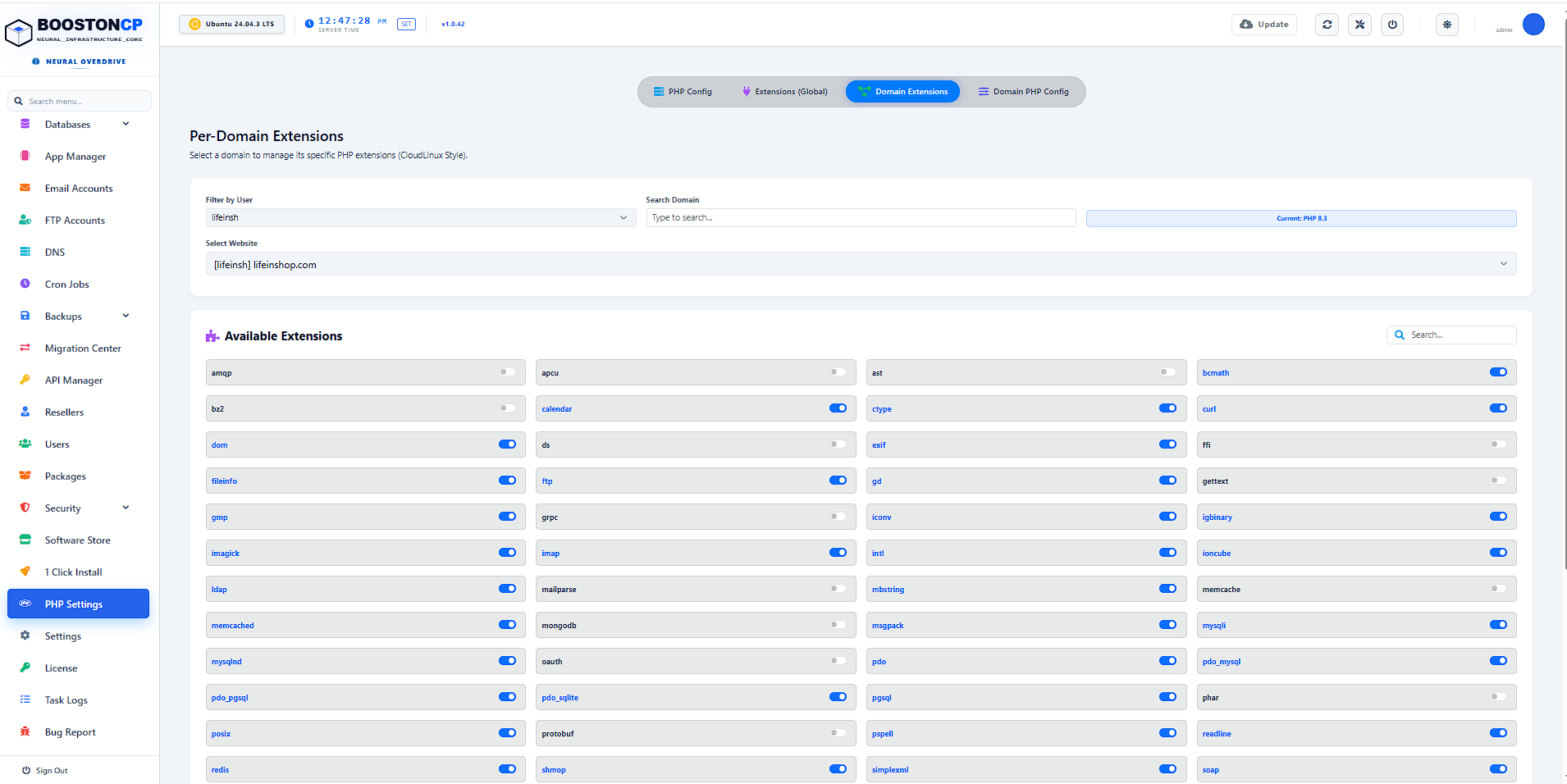
Unlike archaic setups where an admin must run `pecl install` and hope for the best, BoostonCP offers a highly refined Domain Extensions (CloudLinux Style) UI. Within the admin panel, you can select any hosted domain from a dropdown and instantly view a matrix of available PHP modules. With a single click, you can toggle a module ON or OFF. The BoostonCP daemon instantly rewrites the isolated `.conf` file and gracefully reloads that specific FPM pool without dropping a single HTTP request.
If one domain is compromised, the attacker cannot leverage dangerous PHP modules (like pcntl or exec) to traverse the server, because those modules simply do not exist in their specific FPM worker memory space.
2. Empowering the End-User (Zero Support Tickets)
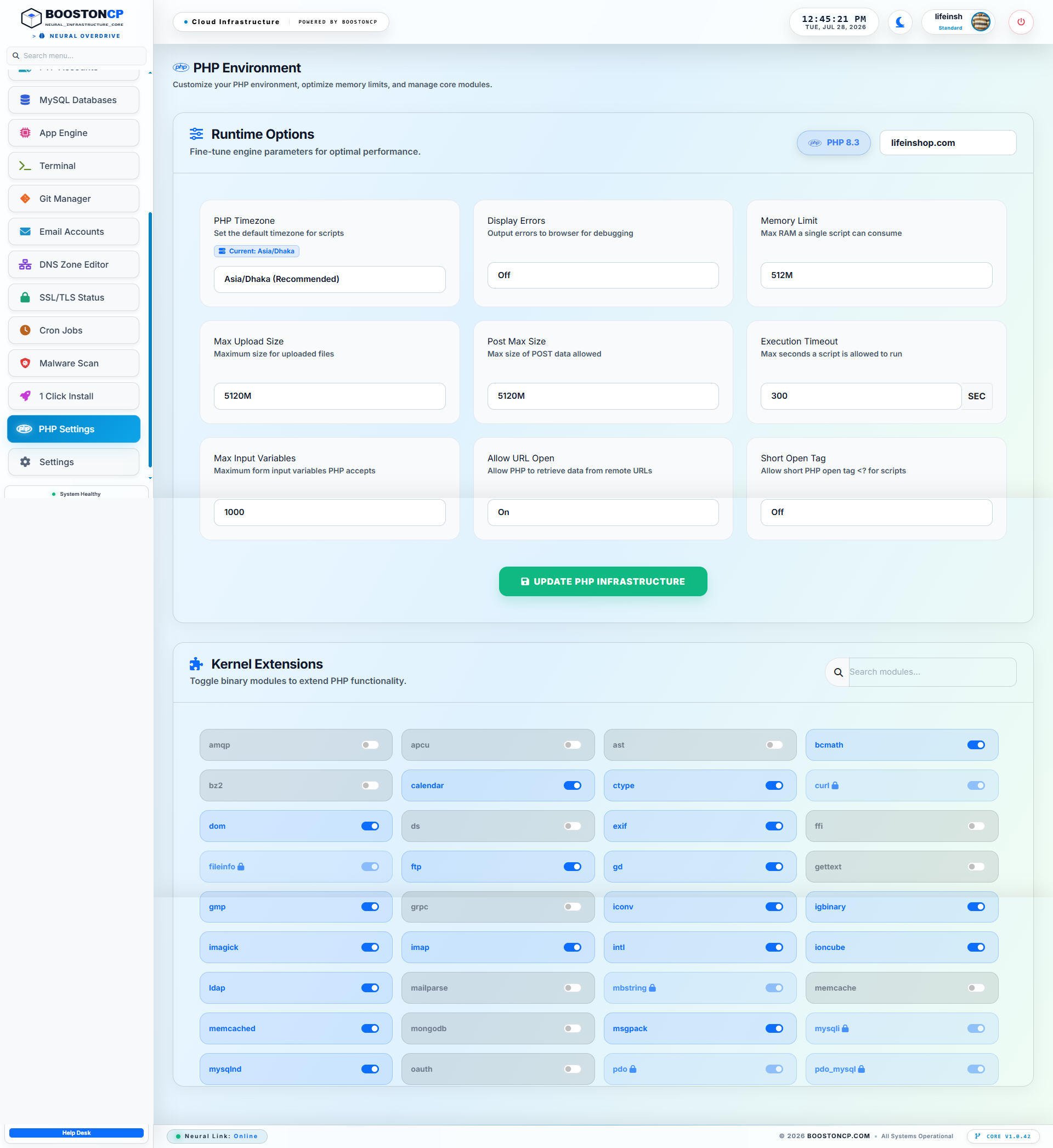
The hallmark of a premium control panel is reducing the workload on the System Administrator. In a traditional shared hosting environment, a client needing the fileinfo extension must submit a support ticket. The admin must then manually edit files or adjust CloudLinux settings.
BoostonCP democratizes this power natively. End-users can log into their beautifully designed, highly secure User Panel, navigate to PHP Settings, and manage their own environment. Because their actions are strictly bounded to their own isolated FPM pool, they have the absolute freedom to toggle extensions, adjust their max_execution_time, and bump their memory_limit (up to the strict ceiling defined by their Cgroups v2 package).
This self-serve architecture eliminates hundreds of minor technical support tickets, saving agencies massive amounts of time and operational capital.
3. Global vs Local Configuration Matrices
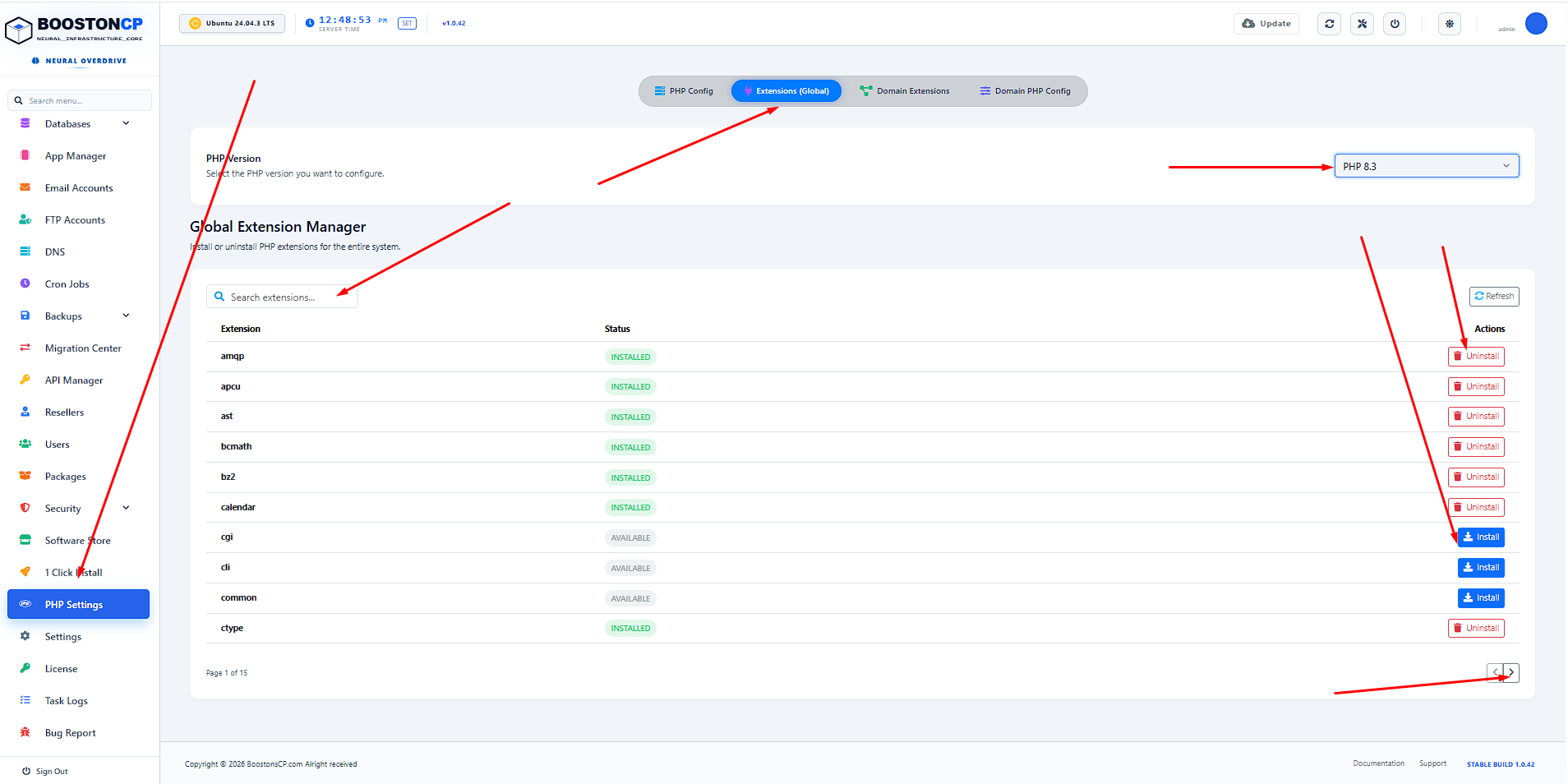
While per-domain isolation is critical, sometimes an admin does want a module globally available (e.g., standard modules like curl, mbstring, or pdo_mysql). BoostonCP manages this through a sophisticated quad-tab orchestration system:
- PHP Config: Adjust global parameters like upload sizes and timezone.
- Extensions (Global): A package-manager frontend that safely triggers
apt-get installorpecl installin the background, compiling massive modules globally without ever hanging the UI. - Domain Extensions: The CloudLinux replacement. Turn extensions on/off exclusively for a single website.
- Domain PHP Config: Override
php.inivalues (like memory_limit) for one specific domain natively.
4. The Synergy with Bubblewrap (CageFS Alternative)
A PHP Selector is useless if the underlying filesystem is exposed. CloudLinux relies on CageFS to lock users into a virtualized filesystem. BoostonCP achieves identical, impenetrable security using Bubblewrap (bwrap) Namespace Jailing.
When a PHP-FPM process spawns, or when a user accesses the Secure Jailshell Web Terminal, they are instantly injected into an unprivileged Linux namespace. They are strictly chrooted to their specific /www/wwwroot/domain path. System binaries (/bin, /usr) are mounted as read-only. The user is entirely blind to the existence of Nginx, MySQL, or any other hosting accounts on the server. BoostonCP delivers full CageFS alternative security utilizing modern, zero-cost Linux containerization technologies.
The Data Comparison: CloudLinux vs BoostonCP Native Pools
Let's analyze the technical differences between the expensive legacy approach and BoostonCP's modern, native orchestration.
| Feature Element | CloudLinux PHP Selector | BoostonCP (Native FPM Pools) | | :--- | :--- | :--- | | **Underlying Mechanism** | Proprietary LVE wrappers | Native `php_admin_value` socket injection | | **Licensing Cost** | $14 to $20+ per server / month | **$0 (100% Free forever)** | | **RAM Efficiency** | Maximum (Requires LVE daemon overhead) | Maximum (Modules load only in specific workers) | | **Security Isolation** | Relies on paid CageFS | Relies on free Bubblewrap Namespace Jails | | **Granularity**| Per-User Account | **Per-Domain (Highest precision)** | | **End-User Control** | Yes | Yes (Fully autonomous UI) |The data is clear. By migrating your web hosting nodes to BoostonCP, you unlock superior, granular control over your PHP environments while entirely eliminating third-party OS licensing fees.
Mandatory USPs: Why BoostonCP is the Ultimate Control Panel
Per-domain PHP isolation is a monumental engineering achievement, but it is just one component of what makes BoostonCP the most advanced hosting control panel on the market today. We refuse to nickel-and-dime our users. We build features that legacy panels simply cannot architect.
World's Only Domain-Level Webserver Switch
In traditional control panels (like cPanel, Plesk, or aaPanel), the entire server is bound to a single webserver ecosystem. If you choose Apache, every single domain runs Apache. If you want the speed of OpenLiteSpeed, you must recompile the entire server globally, resulting in massive downtime for all clients. This monolithic design is a massive bottleneck for modern agencies.
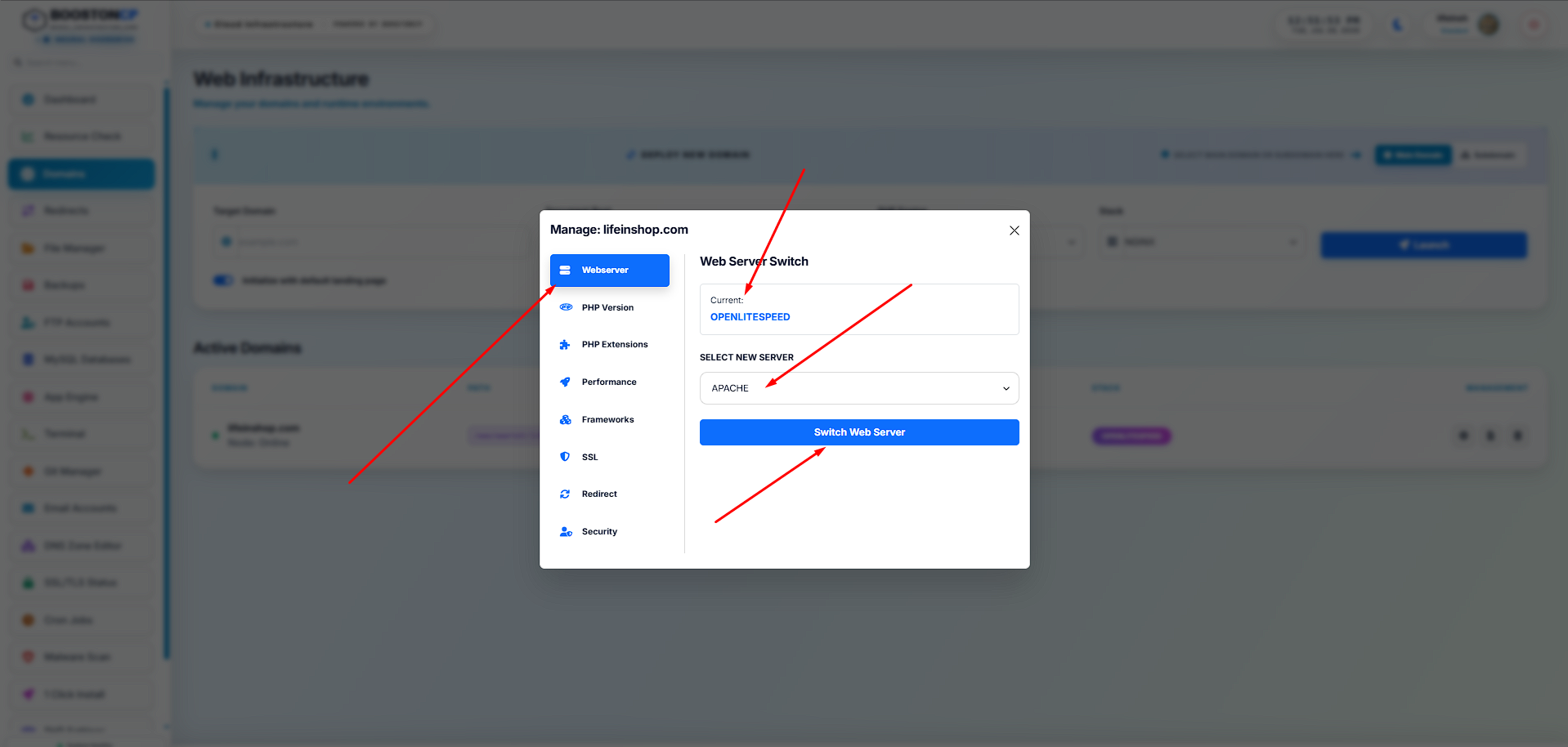
BoostonCP is the ONLY control panel in the world that can switch webservers on a strict per-domain basis. Utilizing our exclusive Dynamic Edge Routing architecture, Domain A can run on raw Nginx, Domain B on legacy Apache, and Domain C on high-speed OpenLiteSpeed—all simultaneously on the exact same server. Switching a domain's web engine takes less than one second and causes absolutely zero downtime for the rest of the node. To understand the raw power of these engines, read our benchmark on Nginx vs OpenLiteSpeed vs Apache in 2026.
Lifetime Free License with Unlimited Websites
The hosting industry has become plagued with predatory pricing models. Competitors offer "Free" versions that artificially hard-cap you at 5 or 10 websites, forcing you into expensive tiers just to host a few more client domains.
BoostonCP ends this extortion with a genuine Lifetime Free License that allows you to host UNLIMITED websites. There are absolutely no domain caps. The only restriction on the free tier is structural for massive B2B reselling: it allows the creation of exactly 1 Reseller and 1 Standard User account. However, because the BoostonCP Admin acts as both the Root Administrator and a User simultaneously, you do not even need to create a separate user account to host your own infinite portfolio of domains. Get unparalleled Enterprise features without the enterprise price tag.
Conclusion: Embrace Native Performance
The era of relying on third-party, paid OS patches to manage simple PHP configurations is officially over. The modern Linux operating system, combined with the power of PHP-FPM and Bubblewrap namespaces, provides all the tools necessary for ultimate security and resource isolation.
BoostonCP acts as the perfect orchestrator, translating complex socket-level configurations into a beautiful, intuitive UI that empowers both SysAdmins and end-users. Stop paying the software tax. Experience native performance, unmatched security, and the freedom of per-domain isolation by upgrading to BoostonCP today.
Frequently Asked Questions (FAQ)
What is the best CloudLinux PHP Selector alternative in 2026?
The best alternative is utilizing native PHP-FPM pool directives. BoostonCP automates this process, allowing you to inject php_admin_value extension commands directly into isolated domain sockets, providing CloudLinux-level extension toggling without any licensing fees.
Does per-domain PHP isolation improve server performance?
Yes, drastically. By isolating heavy extensions (like imagick, redis, or opcache) only to the specific domains that require them, you prevent unnecessary RAM bloat across the rest of the server's PHP processes, keeping your node lean and highly responsive.
Can end-users manage their own PHP settings in BoostonCP?
Absolutely. BoostonCP features an autonomous User Panel where clients can safely toggle their own PHP kernel extensions and modify runtime options (like memory_limit and max_execution_time) per-domain, entirely eliminating technical support tickets.
How does BoostonCP secure users without CageFS?
BoostonCP replaces CloudLinux's CageFS by utilizing modern Linux Bubblewrap (bwrap) Namespace Jailing. This technology strictly chroots the user to their specific document root, rendering system binaries and other user files completely invisible and inaccessible, natively within the OS layer.
Stop Paying the Software Tax Today
Experience native Linux PHP isolation, namespace jailing, and the world's only per-domain webserver switch. Deploy BoostonCP today and instantly upgrade your server architecture.