Executive Technical Summary: Enterprise Multi-Layer Server Defense & Developer Sovereignty
For over two decades, the web hosting industry has been trapped in an expensive and fragmented software licensing cycle. To build a secure, high-performance shared hosting node on legacy control panels like cPanel or Plesk, server administrators have been forced to stack costly add-on subscriptions: cPanel Premier ($60/mo) + CloudLinux OS ($18/mo) + Imunify360 ($25/mo) + JetBackup ($7/mo) + LiteSpeed Enterprise ($20/mo) + Softaculous ($3/mo). This creates an annual software tax of $1,500 to $2,500+ per bare-metal node or VPS. Worse, these monolithic third-party plugins consume 1.5GB to 2.5GB of RAM just sitting idle, severely starving client websites of hardware resources and causing sudden CPU throttling.
Yet, deploying an unhardened Linux VPS is an open invitation to catastrophe: automated botnets continuously probe Port 22 (SSH) and Port 21 (FTP), malicious PHP webshells exploit outdated WordPress plugins, Layer 7 HTTP flood attacks crash database connection pools, and cross-account symlink traversal attacks compromise neighboring tenants on shared servers. Small business owners and developers who purchase affordable $5/month cloud VPS instances often turn to cheap, buggy open-source control panels—only to suffer frequent downtime, broken mail systems, and malware infections.
Booston Control Panel (BCP) replaces this broken paradigm with BCP system hosting. Powered by an ultra-fast compiled GoLang binary core (/usr/bin/booston-core), BCP delivers an all-inclusive hosting operating system with a 100% Lifetime Free License. It natively integrates Domain-Level Webserver Switching (OpenLiteSpeed/Nginx/Apache in 1 second with 0 downtime), Linux Kernel cgroups v2 Tenant Sandboxing, Built-in Sentinel Malware Quarantine (running in ~280MB RAM), Automated Incremental Remote Disaster Recovery, Domain-Level Anti-DDoS Under Attack Mode, Live MySQL Governor Telemetry, Modern Full-Stack Developer Engine (Node.js, Next.js SSR, Python, Ruby, Git CI/CD, Monaco Editor, Web Terminal, WP-CLI, Staging), Cryptographic Port Segregation (Port 2083 vs 2087), and JailShell Chroot Isolation. With BoostonCP hosting system, you achieve fortress-grade Linux server security where cross-account compromise is impossible, while leaving 85%+ of your server's RAM purely for active visitor traffic.
1. What is BCP System Hosting? The Next-Generation Hosting Architecture
When system administrators, web hosting providers, digital agencies, and developers search for BCP system hosting, bcp hosting system, or boostoncp hosting system, they are searching for a modern infrastructure model that eliminates bloated software dependencies without sacrificing enterprise stability. BCP (Booston Control Panel) is not an interpreted collection of slow PHP scripts; it is a unified Linux hosting operating system engineered for extreme speed, enterprise security, and hardware efficiency.
Unlike legacy hosting panels that rely on sluggish interpreted shell loops and scattered cron jobs, BoostonCP executes all core system operations through a compiled native GoLang binary (/usr/bin/booston-core). Whether provisioning a new multi-domain virtual host, binding an SSL certificate, enforcing kernel resource boundaries, or configuring firewall netfilter chains, the GoLang binary completes tasks in sub-milliseconds with zero memory leaks and negligible CPU overhead.
At the heart of the BCP hosting system lies six fundamental architectural breakthroughs:
- Compiled GoLang Binary Core: All backend tasks, user provisioning, virtual host generation, and firewall enforcement execute via
/usr/bin/booston-corein sub-milliseconds with zero memory leaks. - Domain-Level Webserver Switcher: Switch between OpenLiteSpeed (with LSCache and HTTP/3 QUIC), Nginx FastCGI, and Apache Event MPM per domain in 1 second with 0 downtime.
- Native Kernel Sandboxing (cgroups v2): Enforces strict CPU and RAM ceilings without requiring CloudLinux OS ($18 to $35/mo).
- Built-in Sentinel Malware Quarantine: Dual-engine ClamAV and LMD scanner that neutralizes PHP webshells in real time without eating server RAM.
- Zero-Data Loss Remote Disaster Recovery: Automated incremental backups to Google Drive, S3, and SFTP with 1-click bare-metal restoration.
- Microscopic 280MB RAM Footprint: Leaves 85%+ of VPS hardware resources dedicated to active website visitors.
2. Built for Everyone: The 3 Personas Liberated by BCP System Hosting
BoostonCP was engineered from the ground up to solve the distinct security and infrastructure crises faced by three primary groups in the web ecosystem:
1. The $5 VPS User & Small Site Owner
The Reality: Hundreds of thousands of individuals purchase a $5/month cloud VPS (1GB or 2GB RAM) from providers like Hetzner, DigitalOcean, or Vultr. Because commercial cPanel licenses ($40+/mo) cost eight times more than their entire server, they install cheap free open-source panels. Within weeks, their websites get hacked, outgoing emails land in Spam or fail completely, and database services crash due to memory leaks. They cannot afford $50 to $100/mo for CloudLinux and Imunify360.
The BCP Fix: BoostonCP grants a 100% Lifetime Free License. The $5 VPS owner receives enterprise-grade Sentinel malware scanning, stateful firewall rules, kernel resource isolation, automated SSL, and high-deliverability mail servers—while all services combined consume just ~280MB to 300MB of RAM!
2. The Modern Full-Stack Developer
The Reality: Modern developers build applications using Node.js, Next.js Server-Side Rendering, Python (FastAPI/Django), and Ruby on Rails. Legacy control panels treat non-PHP applications as an afterthought, forcing developers into complex reverse-proxy configurations, broken PM2 supervisors, and permission errors.
The BCP Fix: Built-in Multi-App Runtime Engine with 1-click port routing, automated PM2 daemon supervision, Git CI/CD webhook deployments, browser-based Monaco code editor, native web terminal, and live real-time log telemetry.
3. Hosting Providers & Resellers
The Reality: Following WebPros' predatory per-account price hikes, commercial web hosts and digital agencies have seen their profit margins decimated. Stacking cPanel, CloudLinux, Imunify360, and JetBackup costs over $150/month per physical node.
The BCP Fix: There is no viable alternative to BoostonCP. With native multi-tier reseller management, 100% white-label branding, WHMCS billing automation, and built-in kernel isolation, hosts eliminate third-party license bills entirely and keep 100% of their hosting revenue.
3. The Industry Dream: Domain-Level Webserver Switching (1-Sec, 0 Downtime)
In traditional control panels like cPanel or Plesk, webserver architecture is a rigid, server-wide monolith. If an administrator wishes to deploy OpenLiteSpeed to leverage native LSCache for WordPress sites, the entire server must be switched or recompiled. This server-wide change often breaks custom Apache .htaccess rewrite rules, disrupts custom Nginx reverse proxy configurations, and causes extended downtime across all client websites.
As explored in our Hybrid Webserver Architecture Solutions, BoostonCP turns the web hosting dream into reality by decoupling webserver selection from the global server stack:
- Per-Domain Webserver Sovereignty: Every user and administrator can select between OpenLiteSpeed (with LSCache and HTTP/3 QUIC), Nginx FastCGI, and Apache Event MPM on a per-domain basis directly from their control dashboard. Domain A can run OpenLiteSpeed for an e-commerce WordPress store, while Domain B runs Nginx FastCGI for a REST API, and Domain C runs Apache for a legacy PHP application.
- Instant 1-Second Switch with 0 Downtime: The GoLang core dynamically reconfigures vhost routing and upstream socket proxies in under 1 second without restarting the core web daemon. Active visitors browsing the site never experience dropped TCP connections or HTTP 502 Bad Gateway errors.
- Zero Error Validation Engine: Before applying webserver changes, BoostonCP tests configuration syntax against isolated virtual host templates. If an invalid directive is detected, the change is rolled back automatically with zero service interruption.
4. Zero-Data Loss Remote Disaster Recovery: 1-Click Bare-Metal Restoration
The ultimate nightmare for any web hosting company, agency, or sysadmin is catastrophic hardware destruction: a server's NVMe SSD abruptly burns out, or a physical datacenter suffers an unrecoverable power failure. In legacy environments, disaster recovery is an agonizing process taking days of manual OS reinstallation, recreating user accounts, reconfiguring DNS records, and dealing with corrupted database dumps. The resulting downtime causes severe business reputation damage and irreversible customer loss.
As detailed in our Disaster Recovery Solutions Guide, BoostonCP replaces expensive backup plugins like JetBackup ($7 to $10/server/month) with a native, enterprise disaster recovery subsystem:
- Incremental & Standard Remote Backups: Schedule automated incremental snapshots to Google Drive, AWS S3, Wasabi, Backblaze B2, or remote FTP/SFTP storage nodes. Incremental backups transfer only modified blocks, saving bandwidth and remote storage costs.
- 1-Click Bare-Metal Restoration: If your server is completely destroyed, simply provision a fresh Linux VPS, install BoostonCP with a single command, connect your remote storage credentials, and click Restore. BoostonCP reconstructs every virtual host, Let's Encrypt SSL certificate, MariaDB database, user permission, Cron job, and Maildir email inbox identically within minutes.
- Zero Local Disk Consumption: Backups are streamed directly to remote storage repositories in chunked multi-part streams, eliminating temporary archive bloat that often fills local root partitions and crashes servers during backup generation.
5. Eliminating the CloudLinux Tax: Native Kernel cgroups v2 & Visitor Limits
In the traditional shared hosting world on cPanel, web hosts are trapped into purchasing CloudLinux OS ($18 to $35/server/month) for Lightweight Virtual Environment (LVE) isolation. Without CloudLinux, a single hacked WordPress site or runaway PHP script executing an infinite loop can consume 100% of the server's CPU and RAM, bringing down every other tenant on the node (the infamous "Noisy Neighbor" syndrome).
As explored in our Tenant Isolation & cgroups v2 Blueprint and Resource Governance Solutions, BoostonCP leverages modern Linux Kernel cgroups v2 to provide hard hardware boundaries directly in the OS—at zero licensing cost:
- Hardware-Enforced CPU Quotas (
cpu.max): Assign precise CPU slices to each hosting package (e.g.CPUQuota=100%for 1 core). Even if a malicious PHP script spawns hundreds of child processes, the kernel throttles the tenant to their allocated ceiling without affecting other sites. - Hard Memory Ceilings (
memory.max): If a compromised tenant script attempts to allocate 4GB of RAM on a 2GB VPS, the Linux kernel instantly invokes the Out-Of-Memory (OOM) killer on the offending child process only. The server remains online, and neighboring tenants experience zero degradation. - Per-Domain Visitor Limits: Set maximum concurrent visitor caps per domain. If a single client site goes viral or gets scraped by aggressive bots, BoostonCP throttles excess requests at the webserver layer before backend hardware resources are exhausted.
- Per-Domain Under Attack Mode: Toggle instant Layer 7 anti-DDoS challenge rate limiting on a specific victim domain with a single click, mitigating HTTP floods without affecting any other site on the machine.
6. Per-Domain PHP Freedom vs. CloudLinux Global User Constraints
A major operational limitation in CloudLinux PHP Selector on cPanel is that PHP extensions and configurations are bound globally to the user account. If a single user account hosts multiple websites (e.g., a modern Laravel application alongside a legacy WordPress store), changing a PHP extension or memory limit alters the environment for all domains under that user. If the legacy site requires an older extension (like ionCube or imagick) or a low memory ceiling, that setting is forced onto the modern application.
BoostonCP gives users complete per-domain PHP sovereignty:
- Independent PHP Versions Per Domain: Run PHP 7.4 on Domain A, PHP 8.1 on Domain B, and PHP 8.3 on Domain C—all under the same user account with zero conflicts.
- Granular Extension Toggles Per Domain: Enable or disable specific PHP extensions (OPcache, Redis, Memcached, Imagick, Swoole, ionCube) individually for each specific virtual host.
- Per-Domain php.ini Overrides: Customize
memory_limit,upload_max_filesize,post_max_size, andmax_execution_timeper vhost without server-wide configuration clashes.
7. Live MySQL Governor & Real-Time Database Telemetry
Un-indexed database queries, runaway joins, and table lock contention are the most common causes of unexpected web server freezes. In CloudLinux, MySQL Governor is a proprietary add-on requiring separate licensing and complex CLI configuration.
In BoostonCP, Database Governance and Real-Time Telemetry are natively built into the core interface:
- Real-Time Query Telemetry: Administrators and users can inspect running database threads, slow queries, and active lock contention in real time through an interactive visual monitor.
- Automated Thread Throttling: Identifies hung or runaway database queries and automatically terminates abusive transactions before they exhaust connection pools and trigger MySQL Error 1040 (Too many connections).
- Multi-Engine Database Support: Full visual management for MariaDB, PostgreSQL, MongoDB, and Redis with zero external software licensing fees.
8. Developer Paradise: Multi-Runtime App Engine, Git CI/CD & Monaco Editor
Modern web development extends far beyond traditional PHP scripts. Developers build web applications with Node.js, Next.js Server-Side Rendering, Python (FastAPI/Django), and Ruby on Rails. On cPanel, configuring reverse proxies, process supervisors, and environment variables is an error-prone manual ordeal.
BoostonCP incorporates a native Full-Stack Developer Subsystem designed to maximize development velocity and automate deployment pipelines:
1. Multi-Runtime App Engine (Node.js, Next.js SSR, Python, Ruby)
Deploy modern full-stack applications with 1 click. Select your runtime (Node.js, Python WSGI/ASGI, Ruby), specify your entry file (e.g. server.js, app.py), and BoostonCP automatically configures PM2 process supervision, cluster mode, and OpenLiteSpeed/Nginx reverse proxy routing.
2. Native Git CI/CD & Push-to-Deploy Webhooks
Connect your GitHub, GitLab, or Bitbucket repositories directly. When you execute git push origin main from your local terminal, BoostonCP automatically triggers a secure webhook, pulls the latest commit, runs your build commands (npm install && npm run build or pip install -r requirements.txt), and hot-reloads the application daemon with 0 downtime.
3. Browser-Based Monaco Code Editor (VS Code in Browser)
Edit files directly in the browser using the official Monaco Editor engine (the core powering VS Code). Enjoy full syntax highlighting, intelligent auto-completion, multi-tab editing, and split-screen code diffs without requiring external FTP software.
4. Web-Based Terminal & Jailed SSH Environment
Access a fully functional browser terminal (xterm emulation) secured inside a JailShell chroot environment. Developers can safely execute composer, npm, pip, git, and wp-cli commands directly from their dashboard.
5. 1-Click Staging & Cloning Engine
Never test plugins or major code updates on live production traffic. BoostonCP lets you create a 1-click staging copy of your entire website and database on a staging subdomain (e.g. staging.yourdomain.com), test modifications, and push changes back to production with a single click.
9. Built-in Sentinel Malware Scanner (Imunify360 Killer in ~280MB RAM)
Commercial security suites like Imunify360 charge $16 to $45/server/month while consuming up to 1.5GB of server RAM just idling. BoostonCP's built-in Sentinel Malware Engine delivers enterprise threat mitigation while keeping the entire server footprint at just ~280MB to 300MB RAM:
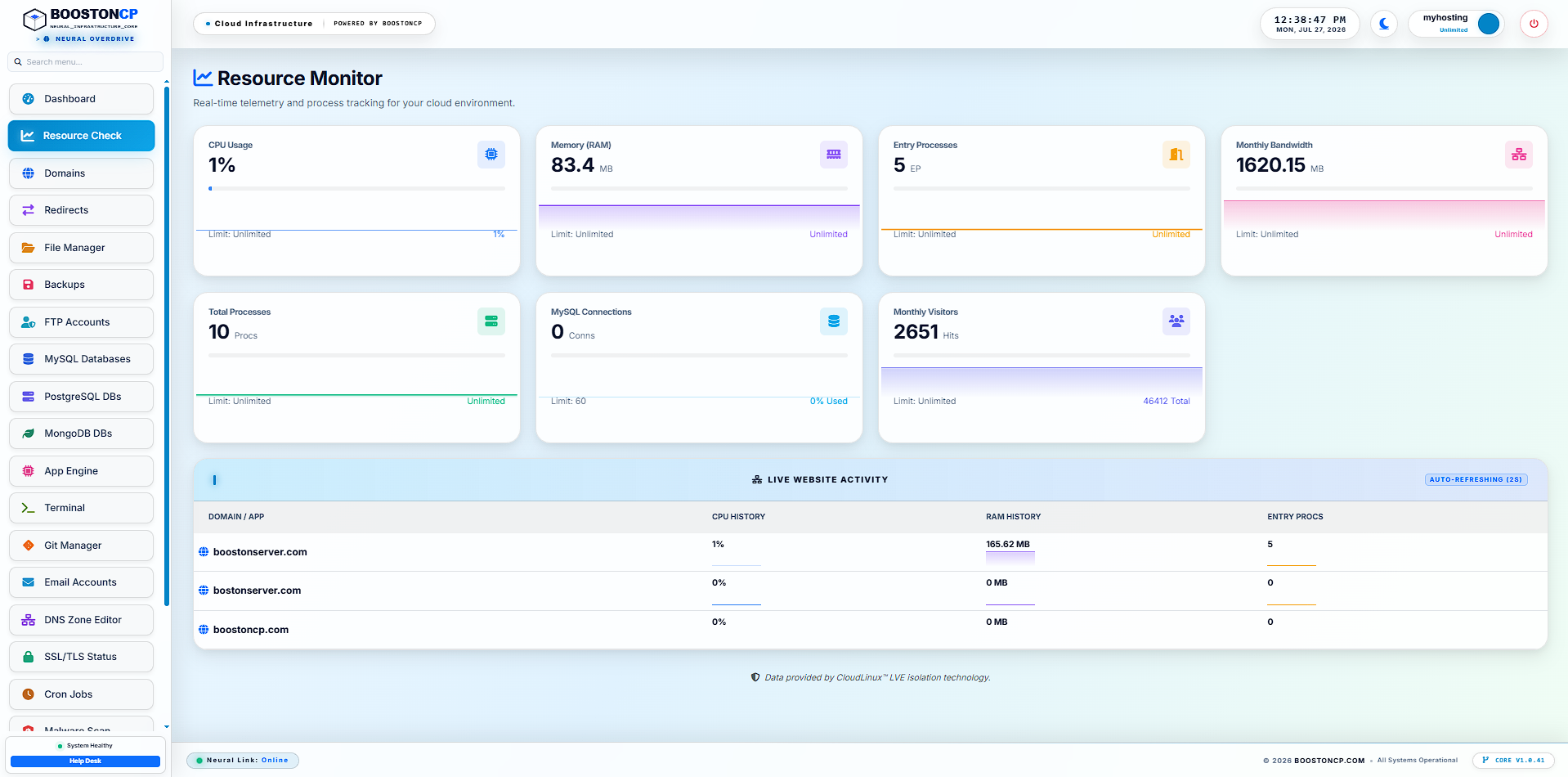
- Dual-Engine ClamAV & LMD Heuristics: Matches file signatures against thousands of known PHP webshells, base64 eval injectors, obfuscated javascript redirectors, and WordPress backdoors in seconds.
- Automated Instant Quarantine: Neutralizes infected files immediately by moving them to
/usr/local/maldetect/quarantine/with permissions set to0000. This completely stops payload execution while preserving files for 1-click administrative review. - Zero-Load Background Throttling: Scans execute under
nice -n 10(CPU priority deprioritization) andionice -c 2(best-effort disk I/O scheduling). Web visitors experience zero latency even while a 50GB file scan is actively running.
10. Port Segregation & JailShell: Why Cross-Account Hacks Are Impossible
In a shared hosting environment, cross-account symlink traversal is the fastest route to a full server compromise. BoostonCP makes cross-account compromise mathematically impossible through strict cryptographic and filesystem boundaries:
- Port Segregation (2083 vs 2087): Port 2083 is dedicated to unprivileged end-user controls, while Port 2087 is strictly reserved for root administrators and WHM resellers with 2FA protection.
- JailShell & Chroot Isolation: SSH/SFTP sessions are restricted to a chroot jail. System shadow files, root directories, and other user folders in
/www/wwwroot/are completely invisible. - Strict open_basedir Jailing: PHP scripts cannot traverse outside their specific document root.
- disable_functions Locking: High-risk execution functions (
exec, passthru, shell_exec, system, proc_open, popen) are automatically disabled.
11. Dual Firewall Matrix: Stateful UFW Engine & CSF / LFD Integration
BoostonCP combines low-overhead kernel packet filtering with intelligent application-layer threat analysis:
Core Firewall Security Policies
- Default Inbound Policy: DROP / DENY ALL unsolicited incoming packets across 65,535 TCP/UDP ports.
- Public Web Traffic: Port 80 (HTTP) & Port 443 (HTTPS) open with SYN flood protection enabled.
- Secure Mail Ports: Port 25 (SMTP Inbound), Port 465 (SMTPS), Port 587 (Submission), Port 993 (IMAPS), Port 995 (POP3S).
- Panel Management: Port 2087 (Admin Dashboard) & Port 2083 (User Dashboard) protected with rate-limiting.
- Internal Services: MariaDB (3306), PostgreSQL (5432), MongoDB (27017), Redis (6379) bound strictly to 127.0.0.1 loopback.
- Login Failure Daemon (LFD): Automatically monitors authentication logs and bans abusive IP addresses after 5 failed attempts within 300 seconds.
12. Next-Gen Multi-Tier Reseller System & 100% White-Label Freedom
For web hosting businesses and digital agencies, BoostonCP delivers a reseller management architecture far more flexible than cPanel's rigid structure:
- Multi-Tier Hierarchy: Create sub-resellers with custom resource allocations (CPU, RAM, disk, bandwidth) and independent package creation rights.
- 100% White-Label Branding: Admins and resellers can brand their client portals with custom logos, themes, custom hostnames (
cpanel.yourbrand.com), and nameservers. - WHMCS Billing Automation: Native WHMCS module allows instant account provisioning, suspension, package upgrades, and termination.
13. 1-Click Zero-Downtime cPanel Migration Engine
Migrating from cPanel to BoostonCP takes minutes with our 1-Click Migration Engine:
- Automated cpmove Parsing: Upload standard cPanel backup archives (
cpmove-*.tar.gz) directly into BoostonCP. - Full Entity Mapping: Automatically restores domains, subdomains, MariaDB databases, user credentials, SSL certificates, Cron jobs, and Maildir mailboxes without broken path errors.
- Zero Downtime Cutover: Preview websites on temporary staging URLs before switching DNS A-records.
14. 3-Year Security & Infrastructure TCO Analysis ($5,400+ Savings Per Server)
Let's compare the true 3-year Total Cost of Ownership (TCO) for running a single high-performance web hosting node:
| Infrastructure Software Layer | Traditional cPanel Stack (Add-Ons) | BoostonCP (BCP System Hosting) |
|---|---|---|
| Base Control Panel License | cPanel Premier ($60.00 / mo) | $0.00 / mo (Lifetime Free) |
| Malware Scanner & Quarantine | Imunify360 ($25.00 / mo) | Sentinel Scanner (Included Free) |
| Tenant Resource Sandboxing | CloudLinux OS ($18.00 / mo) | Native cgroups v2 (Included Free) |
| Remote Incremental Backups | JetBackup ($7.00 / mo) | Disaster Recovery (Included Free) |
| High-Speed Web Server | LiteSpeed Enterprise ($20.00 / mo) | OpenLiteSpeed Switcher (Included Free) |
| Anti-DDoS / Rate Limiting | BitNinja / Cloudflare Pro ($20.00 / mo) | Under Attack Mode (Included Free) |
| 3-Year Total Infrastructure Cost | $5,400.00 / node | $0.00 (100% Net Savings) |
As explored in our Feature Superiority & Compare Matrix, migrating to BoostonCP gives you enterprise-grade infrastructure sovereignty with zero recurring licensing overhead.
15. Production Server Hardening Checklist for Linux Hosting Nodes
Follow this step-by-step checklist to ensure your Linux web hosting server achieves maximum security compliance:
- Disable SSH Root Password Login: Enforce SSH Key authentication and change the default SSH port from 22 to a custom high port (e.g.
2222). - Enable UFW & CSF Stateful Firewall: Ensure default policies drop incoming traffic and allow only essential web, mail, and panel ports.
- Enforce Port Segregation: Restrict Port 2087 Admin/Reseller access with 2FA and brute-force protection.
- Configure Automated Sentinel Malware Scans: Schedule daily background malware scans with automated quarantine enabled.
- Verify JailShell & cgroups v2 Sandboxing: Assign strict CPUQuota and MemoryMax parameters to all hosting packages to prevent runaway resource abuse.
- Enforce Automatic SSL Redirection: Ensure all web traffic is redirected to HTTPS (Port 443) with HSTS enabled.
- Setup Remote Disaster Recovery Backups: As detailed in our Disaster Recovery Guide, configure daily incremental backups to Google Drive or S3 to ensure 1-click restore if hardware fails.
16. Frequently Asked Questions (FAQ)
1. What is BCP System Hosting?
BCP (Booston Control Panel) System Hosting is a lightweight, enterprise-grade Linux web hosting operating platform. Powered by a high-speed GoLang binary core (/usr/bin/booston-core), BCP provides domain-level webserver switching (OpenLiteSpeed/Nginx/Apache), built-in malware quarantine, kernel cgroups v2 isolation, and stateful firewall security while consuming only ~280MB RAM.
2. How does BoostonCP prevent a hacked website from compromising the entire server?
BoostonCP enforces four layers of tenant sandboxing: JailShell/chroot restricted environments, unique UNIX UID/GID boundaries, isolated per-user temporary directories, and strict open_basedir PHP path locking. Even with full shell access, an attacker cannot read neighboring files or system shadow hashes.
3. Why does BoostonCP separate Port 2083 and Port 2087?
Port 2083 is dedicated to unprivileged end-user domain and email management, while Port 2087 is strictly reserved for root administrators and WHM resellers. This cryptographic separation prevents credential stuffing and privilege escalation attacks.
4. Do I need to buy Imunify360 to secure my BoostonCP server?
No. BoostonCP includes the built-in Sentinel Malware Engine which combines ClamAV Daemon and LMD heuristics to scan and automatically quarantine malicious PHP webshells, backdoors, and crypto-miners at zero additional cost.
Fortress-Grade Linux Server Security With Zero Add-On Fees
Protect your web hosting infrastructure with built-in firewall rules, malware quarantine, kernel sandboxing, JailShell isolation, and anti-DDoS on BCP system hosting.